IPO Section | Zero interest, zero fees, zero cash subscription
What is an IPO? How to subscribe to new shares with zero fees, plus a schedule of new stock listings.
At the same time, it explains key dates for Hong Kong stock IPOs, the IPO subscription process, Groups A and B, the "top‑of‑the‑line" allocation, the FINI system, the clawback mechanism, and other technical terms; compares the costs and advantages of cash subscription, Futu financing, and bank financing; and shares investment strategies to increase your chances of being allocated shares and manage leverage risks.
New Stock Listing Schedule (Latest)
With new stocks hitting the market one after another, are you eager to ride the IPO wave and seize profit opportunities? But with a busy schedule, you simply don't have time to pore over hundreds‑page prospectuses. Moreover, mainstream media may not cover every new issue in detail, and with each company setting its own subscription deadline, it's easy to miss the optimal entry point if you're not paying close attention.
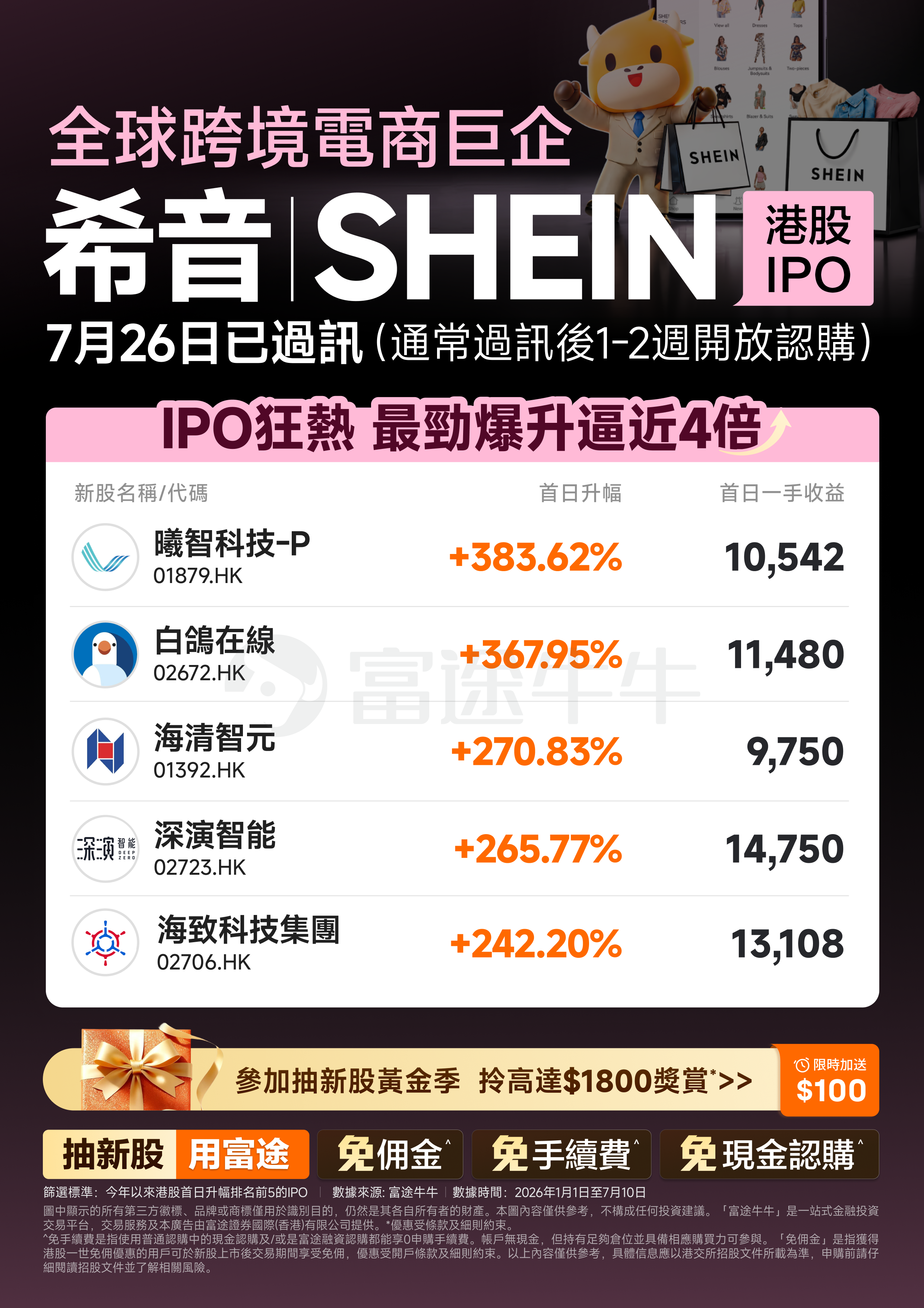
Futubull's[New Stock Center]Provides a clear schedule of new stock listings and all key dates! From the IPO, subscription deadline, pre-market trading to the listing date—everything is easy to see at a glance. Plus, it highlights the key points in the prospectus, including financial performance, business model, and essential information! Open the Futubull App > [Market] > [HK Stocks] > [New Stock Center] to instantly check out the latest new stocks!
What is an IPO?
An IPO, short for "Initial Public Offering," refers to the process by which a company issues shares to the public for the first time, transforming itself from a private entity into a publicly listed company. Generally speaking, an IPO is one of the methods companies use to raise capital, expand their operations, or enhance brand visibility.
What are the benefits of subscribing to new shares?
Potential high returns
Recently, the Hong Kong stock IPO market has regained momentum, drawing widespread attention from investors. To boost their chances of a successful listing, many companies are adopting more attractive pricing strategies. If market response is positive, the subsequent performance of these stocks will be worth watching, offering investors the potential to capture substantial short-term gains.
Participate in emerging companies with long-term growth potential.
If investors can acquire shares in promising growth companies at an early stage and hold onto them, as long as the company continues to grow after its IPO, they can not only enjoy regular dividend payments—assuming the company pays dividends—but also benefit from long-term appreciation of their investment.
Is it a sure thing to make money from IPOs?
IPO investments always come with risks, such as high market volatility and uncertain company performance, so it's essential to conduct thorough research before committing. Overall, however, new shares listed on the Hong Kong stock market in 2026 have shown a generally positive outlook, with gains of up to 659.90% since their debut—enough to pocket over HK$10,000 per lot!
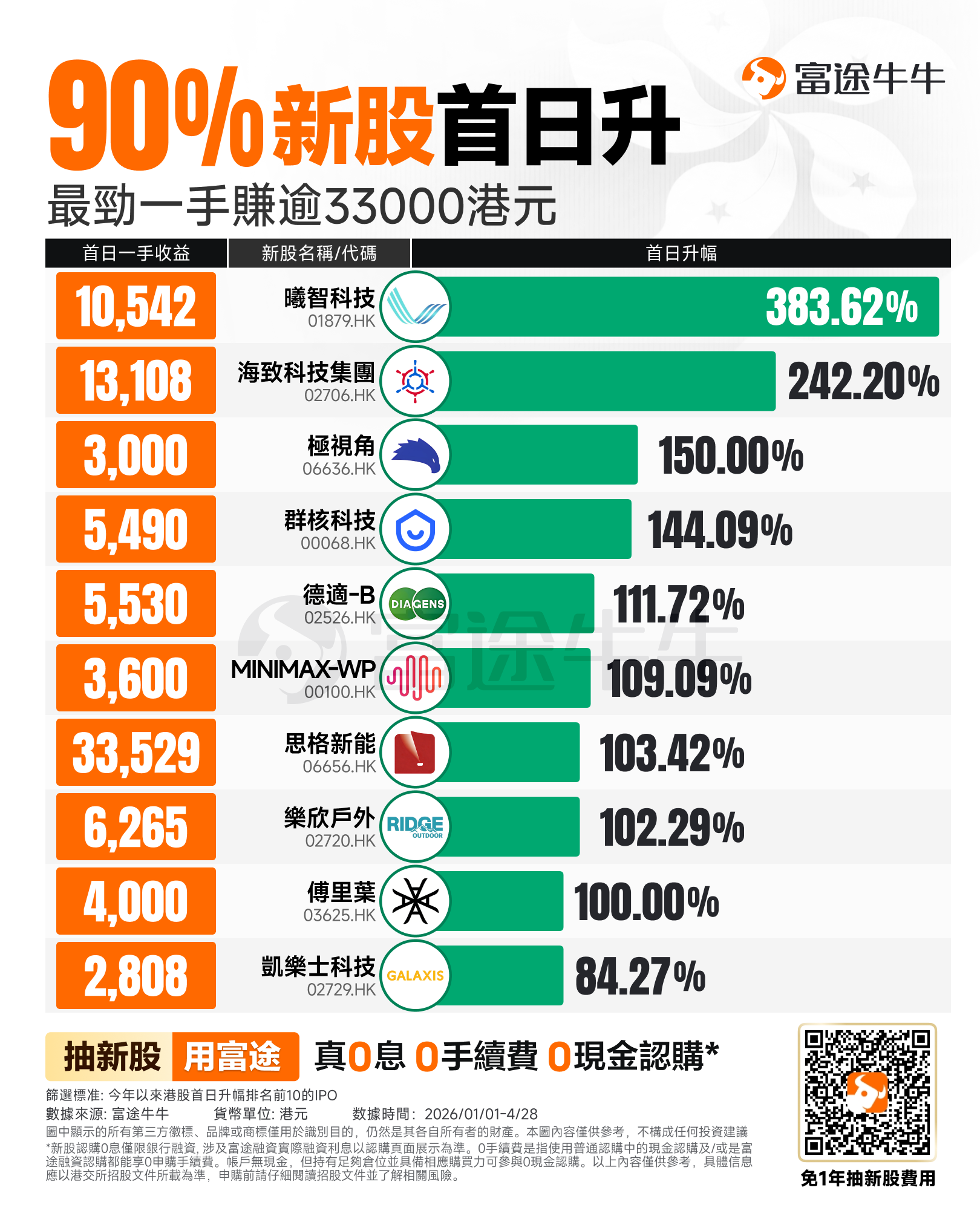
2026 Hong Kong Stock IPO First-Day Returns Ranking
New Stock Name | Stock code | Increase since listing |
Intelligent Spectrum | 02513 | 613.86% |
Xizhi Technology-P | 001879 | 382.26% |
MINIMAX-W | 00100 | 337.58% |
Shangmi Technology-W | 06810 | 284.35% |
Qunhe Technology | 00068 | 185.86% |
Fourier | 03625 | 211.00% |
GigaDevice | 03986 | 185.33% |
DeShi-B | 02526 | 172.53% |
TianShu Intelligent Chip | 09903 | 151.04% |
Extreme Perspective | 06636 | 150.50% |
Lanqi Technology | 06809 | 138.56% |
Kailishi Technology | 02729 | 128.09% |
Biren Technology | 06082 | 120.61% |
Screening criteria: Companies that went public in 2026 and have seen their stock price double since listing. Data period: January 1, 2026 – April 28, 2026.
Independent equity analyst Xiong Liping believes that market sentiment is currently positive, and investors' appetite for subscriptions remains relatively strong. Recent market hotspots have been concentrated in stocks related to artificial intelligence, robotics, semiconductors, and other such sectors, with nearly all newly listed companies falling into these categories, further boosting overall market sentiment. Take the recently listed Biren Technology (6082) as an example: its share price has rebounded from around 30 yuan to near 40 yuan, suggesting that short-term trading could still offer a reasonable risk-reward profile. These types of stocks generally require substantial capital investment yet remain unprofitable; therefore, it will be important to monitor the commercialization of new products, changes in R&D spending, and developments in revenue growth and margin improvement.
Under the new subscription system, the allocation ratio for individual investors is limited. Many investors opt to place large‑size subscriptions in hopes of boosting their chances of winning an allocation, but this is not feasible for every investor, as it depends on their risk‑bearing capacity. Moreover, they must also assess whether they can secure sufficient financing to cover their subscription commitments. For most retail investors, participating in the subscription process often resembles a lottery; it may be wiser to wait until the shares are listed and then select suitable stocks for investment.
100% profit on the first day of a Hong Kong IPO?! Must‑subscribe new shares in 2026 + a guide to subscribing—watch now>>>
What are some tips for applying for new stock offerings?
Futu's chief analyst, Tam Chi-lok, stated that, amid the current fervent IPO market, speculating on new shares no longer relies on luck; instead, investors must carefully select stocks based on industry prospects, shareholder backgrounds, and valuation ranges. He also noted that investors can leverage margin financing to increase their subscription quantities, but should be mindful that if a new share falls below its IPO price, leveraged positions could amplify losses. Therefore, investors should avoid blindly using leverage when subscribing to new issues.
Tan Zhile also cautions investors against "chasing new issues without a clear strategy," advising them to treat IPOs as disciplined short-term plays rather than holding poorly valued new shares indefinitely. Participating in IPOs should be part of an overall capital‑allocation framework; past sharp rallies do not guarantee similar performance going forward, so investors should keep their overall position sizes in check.
What dates should you pay attention to when applying for new stock offerings?
When a company is listed on the Hong Kong Stock Exchange, investors should pay attention to the following key dates:
1. Subscription Period: Typically, the subscription period lasts 3 to 4 days, from the start of the offering to the subscription deadline. To subscribe for new shares, please participate during this period; the company planning to go public will specify the offering dates in its prospectus.
2. Pricing Day: Following the close of the new‑share subscription period, the issuing company and the underwriters jointly determine the final offering price. The pricing day typically falls on the subscription deadline or the next trading day thereafter.
3. Announcement of the Winning Date: On the trading day immediately preceding the listing date of the new share, the listed company will issue an announcement regarding the allocation of the new shares.
4. New Share Listing Date: The new share listing date is the first day the new shares are listed on the stock exchange.
5. Green Shoe Protection Period: For new shares issued with an over-allotment option, the investment bank may exercise this option within one month after the subscription deadline. If the share price falls below the offering price during this period, the investment bank can purchase shares to support the price; if the share price rises sharply, the listed company will issue additional shares to the investment bank.
6. Lock-up Period for Cornerstone Investors: If a company brings in cornerstone investors prior to its IPO, there is typically a six-month lock-up period, during which the shares purchased by these investors may not be sold or cashed out within six months following the listing date. The listed company may also agree with the cornerstone investors on a longer lock-up period.
7. Lock-up period for major shareholders of listed companies: For new shares listed on the Main Board of the Hong Kong Stock Exchange, major shareholders are subject to a six-month lock-up period starting from the date of listing; for new shares listed on the GEM of the Hong Kong Stock Exchange, major shareholders are subject to a two-year lock-up period starting from the date of listing.
How to subscribe for new shares
There are two main ways to apply for new shares: standard subscription and bank‑financed subscription. Futu offers new‑share subscription services, allowing you to apply for new shares with zero interest and zero fees.
Ordinary Subscription | Bank Financing Subscription | |
Subscription Method | 1. Cash only 2. Cash + Futu Financing 3. Pure Futu financing | 1. Cash + Bank Financing 2. Futu financing + bank financing 3. Cash + Futu financing + bank financing |
Benefits | ·Lower subscription fees ·Each new share can be used. ·No need to rush for credit limits. | ·Enjoy preferential interest rates ·Offers up to 10x leverage |
How can I increase my chances of winning a new‑stock IPO lottery?
When a new stock is highly sought after and supply falls short of demand, and you're optimistic about its prospects and want to increase your chances of being allocated shares, you can opt for margin‑based subscription. By leveraging bank financing, you can access up to 10x leverage; the higher the leverage, the greater your odds of securing an allocation. Of course, with higher potential returns comes correspondingly higher risk.
What is the IPO fee?
Looking to subscribe to new IPOs at a lower cost? Here's a guide to subscribing to new shares with zero interest or zero fees!
If you subscribe through the standard (cash) method, you will be exempt from handling fees.
If you subscribe through the standard (Futu financing) method, you will need to pay an annual interest rate of 6.8%;
If you subscribe through bank financing, you can be exempt from bank financing interest and only need to pay a handling fee of HK$100 per transaction. You can choose the subscription method that best suits your investment needs and offers the most favorable terms.
Subscription Method | Subscription Fee Items | Cost | Charging party | Advantage | How to choose |
Cash subscription | Subscription handling fee | 0 | / | 0 Subscription Fee | Lower cost, suitable for non‑popular stocks. |
Futu financing subscription | Subscription handling fee | 0 | / | By pledging held shares as collateral. You can still subscribe to new shares without selling your existing stock. | Cash is tight, and I hold other stocks. |
Futu financing interest | Futu's financing annual interest rate is the same as that of Hong Kong stock margin and short-selling accounts. | Futu Securities | |||
Bank-financed subscription | Subscription handling fee | 100 HKD per transaction | Bank or Futu Securities | Zero-interest bank margin loan Offers up to 10x leverage. (With a single lot of capital, you can subscribe for 50 lots, 100 lots, or even more.) | Suitable for popular new stocks and for drawing multiple new stocks at once. It can improve capital utilization and increase the odds of winning. |
0 |
Learn more about 0% interest and 0 fees.
Right now, with Futu, you can enjoy a one-year waiver on IPO subscription fees. Use Futu for IPOs—zero interest, zero fees, and zero cash subscription!
New Stock IPO-Related Terms
Groups A and B: Applicants participating in the public offering are categorized into Groups A and B (also referred to as Groups A and B). Group A, commonly known as "retail investors," refers to those with subscription amounts below RMB 5 million; Group B, known as "institutional investors" or "large investors," comprises those with subscription amounts exceeding RMB 5 million.
Top-up allocation: The maximum subscription amount, equivalent to half of the number of shares offered in the public offering (before clawback). In other words, it refers to the individual in Group B who subscribes for the largest number of shares.
First‑lot allocation rate: the probability of being allocated a lot when you only subscribe for one lot.
FINI: is a public offering settlement platform developed by the Hong Kong Stock Exchange. Market participants and regulators can jointly manage the settlement process for initial public offerings (hereinafter referred to as "public offerings") on the same platform, thereby shortening the time from new share pricing to the start of trading. With the launch of the FINI system, investors who use Futu to obtain bank financing for new share subscriptions can enjoy a 0% interest rate, saving significantly on margin loan interest.
Redemption Mechanism: During the IPO process, the issuer dynamically adjusts the allocation ratio between institutional investors and retail investors based on the final subscription results. When demand for the new shares is strong, a portion of the shares can be reallocated from institutional investors to the public offering, thereby more effectively meeting market demand and ensuring a balanced participation opportunity for different types of investors.
Mechanism A (with a callback mechanism)
The initial proportion offered to the public is relatively low (e.g., around 5%).
A clear over-subscription trigger is in place: when the public offering portion is oversubscribed by a specified multiple, the allocation ratio will be progressively increased (e.g., up to approximately 35%).
Automatically increase the share allocation for retail investors based on subscription demand in the retail market.
Mechanism B (Fixed Ratio)
The issuer must determine the proportion of shares to be offered publicly in a single step prior to the offering; the typical range for this choice is between 10% and 60%.
Once determined, the allocation ratio will remain fixed and will not be adjusted even if the public offering is oversubscribed.
Emphasize the stability and predictability of the issuance structure.
Special Arrangement: For technology companies, share allocation is subject to separate rules (pursuant to Chapter 18C of the Listing Rules):
The initial offering ratio is typically set at a relatively low level of around 5%.
Only when the public offering is oversubscribed by a specified multiple can the allocation ratio be increased to approximately 10% or 20% according to the pre‑set tiers, with a smaller clawback flexibility compared to Mechanism A.
Past Hot IPOs and New Stocks
ThroughDark pool trading, with the highest per‑lot return reaching HK$4,200. Below are some of the previously popular IPOs:
[New Stock 1276 IPO] Hengrui Medicine's IPO saw a 27.8% gain in the after-hours trading session.
[New Stock 1364 IPO] Guming's IPO prospectus shows the grey market closed up over 10%
[New Stock 0325 IPO] Bruder's listing update: the grey market saw a peak gain of over 82%
[New Stock 1318 IPO] Mao Geping's IPO prospectus shows the grey-market closing price up by over 50%
[New Stock 2432 IPO] Yuejiang's IPO details: the grey market closed up 8.78%
[New Stock 2431 IPO] Yu Jia Innovation's IPO details: the grey market closed up nearly 8%
[New Stock 2506 IPO] iFlytek Medical Technology closed up nearly 3% in the after-hours market.
