How to play virtual currencies?
What is stablecoin? Full analysis from stablecoin bills to RWA
What is stablecoin?
Stablecoins are a cryptocurrency that is linked to a legal currency, such as the US dollar, whose price is stable and has recently become a hot topic in the financial markets.
As of June 4, 2025, the global stablecoin value has exceeded US$230 billion (Chainalysis Report), and the passage of the latest bill is pushing this area into a new phase. From regulatory changes to investment opportunities, a new trend has opened up for integration with traditional assets. Today we will introduce the latest stablecoin bill, long-term development prospects, and find relevant investment opportunities for everyone.
The Latest Stable Currency Bill in Hong Kong and the United States
The rapid growth of stablecoins has attracted global regulatory attention, and recent legislation in Hong Kong and the United States has led to the start of industry regulation.
Hong Kong's Stable Currency Bill: On 21 May 2025, the Legislative Council of Hong Kong passed the Stable Currency Bill requiring issuers to obtain licences and manage reserve assets to protect investors. This makes Hong Kong the leader in digital finance in Asia.
US GENIUS BILL: The US Senate is considering the “GENIUS Act,” expected to pass in early June, which focuses on the regulation of paid-for stablecoins, including anti-money laundering and bankruptcy protection. This will inject confidence into the US stablecoin market.
Overall, these bills aim to improve market transparency, attract more business participation, while providing a safer environment for investors. From my personal point of view, Hong Kong's bill is expected to further boost its position as a digital asset centre in Asia, while the US bill aims to ensure market stability through federal regulation, avoiding systemic risks such as a TerraUSD crash.
Similarities between the two stablecoin bills
Licensing System: Both bills require stablecoin issuers to obtain a license, a core measure to ensure market regularization. Hong Kong law requires publishers to apply for a licence to the HKMA, while the US GENIUS Act stipulates that publishers must be licensed publishers and are designed to regulate market participants.
Reserves and Risk Management: Both emphasize the need for issuers to maintain sufficient reserves to support stable currency values and implement risk management measures to protect investors and financial stability. For example, the Hong Kong law requires reserve asset management, while the US law explicitly requires 1:1 reserve support.
INVESTOR PROTECTION: BOTH BILLS ARE AIMED AT PROTECTING INVESTORS, THE HONG KONG BILL ENSURES CONSUMER RIGHTS BY PROHIBITING FRAUDULENT TRANSACTIONS, AND THE U.S. LAW PROTECTS CONSUMERS BY PROHIBITING MISLEADING MARKETING AND BANKRUPTCY PRIORITY.
What are the differences between the two stablecoin bills
Scope: The Hong Kong Bill focuses on fiat currency reference stablecoins, which are often linked to specific fiat currencies (such as HKD) to emphasize the stability of the local market. While the US GENIUS Act applies more broadly to payment-based stablecoins, which focus on digital assets for payments and settlements, reflecting the US market's emphasis on stablecoin's role in global payments.
Regulators: Regulation in Hong Kong is unified by the HKMA, embodying the regulatory model of central ownership. While U.S. law allows federal and state-level regulation to coexist, with issuers with smaller issuers opting for state-level regulation, this distribution model fits well with the structure of the U.S. federal system.
Additional Provisions: U.S. law includes detailed provisions for anti-money laundering (AML), interoperability, and bankruptcy procedures, such as requiring issuers to comply with the Bank Secrecy Act and prioritize the claims rights of stableholders in the event of bankruptcy. These elements are not specifically highlighted in the summary of the Hong Kong law, and may be due to the fact that some of the relevant requirements are covered by the regulatory framework of Hong Kong, but no details are available.
How are Fixed Currency Combined with Real Assets?
Stable coins can be combined with physical assets, and the development of stablecoins is not only limited to the cryptocurrency itself, but also to the digitization of Real-World Assets (RWAs). Simply put, RWA is about converting traditional assets such as real estate, art, into digital form so that more people can buy and sell and invest.
What is RWA?
RWA (Real-World Assets) transforms physical assets (such as a house or a painting) into digital tokens, similar to stocks, through blockchain technology. For example, in 2018, the American company Elevated Returns branded Aspen Ridge Resort, allowing small investors to participate (arXiv case).
Market Potential: As of April 2024, the total locked value (TVL) of RWA in Decentralized Finance (DeFi) exceeds $6 billion and is expected to grow to $16 trillion by 2030 (CoinGecko Report).
The role of stablecoins: A stablecoin (such as USDC) as a trading currency reduces the risk of price volatility in RWA and makes investments more stable. For example, Ondo Finance's RWA project has a TVL of $221.42 million in 2024, with an annualized return rate of 4.5% -7.76% (CoinGecko Data).
Future Trends: As technology advances, RWA may cover new areas such as carbon credit, intellectual property, and the combination with stablecoins will create more wealth opportunities.
How to buy stablecoins
The development of stablecoins and RWAs has brought a new hot spot for investors. Stablecoin-related cryptocurrencies and stablecoin concept stocks are worthy of attention:
Investing in Stable Currencies-Related Cryptocurrencies
Stable Coin Tech Supporter: Chainlink (LINK) $ LINK/USD (LINKUSD.CC)$ Provides data connection services, supports RWA and stablecoin applications. Avalanche(AVAX) $ Avalanche Coin (AVAX.CC) $ It is favored because it supports RWA tokenization.
The leader of stablecoins: $Circle(CRCL.US)$ The IPO of US stocks will be the focus this week, as the issuing company for USDC. In addition, cooperation companies in the Tether (USDT) ecosystem also have potential, such as $Coinbase(COIN.US)$ This type of crypto transaction.
Investment Stabilized Currency Concept Shares
A number of financial companies are also focusing on the development of RWA. $JPMorgan(JPM.US)$ $Bank of America(BAC.US)$ $Citigroup(C.US)$ $Wells Fargo & Co(WFC.US)$ Major US banks are launching stablecoins or developing their own platforms to explore blockchain applications. In Hong Kong, there have been quite a few startups and advanced-platform concepts in Hong Kong recently. Includes the chart below $ZA ONLINE(06060.HK)$ $LIANLIAN(02598.HK)$ $STANCHART(02888.HK)$ $CHINA EB LTD(00165.HK)$ $JD-SW(09618.HK)$ $OSL GROUP(00863.HK)$ $LINKLOGIS-W(09959.HK)$ 。
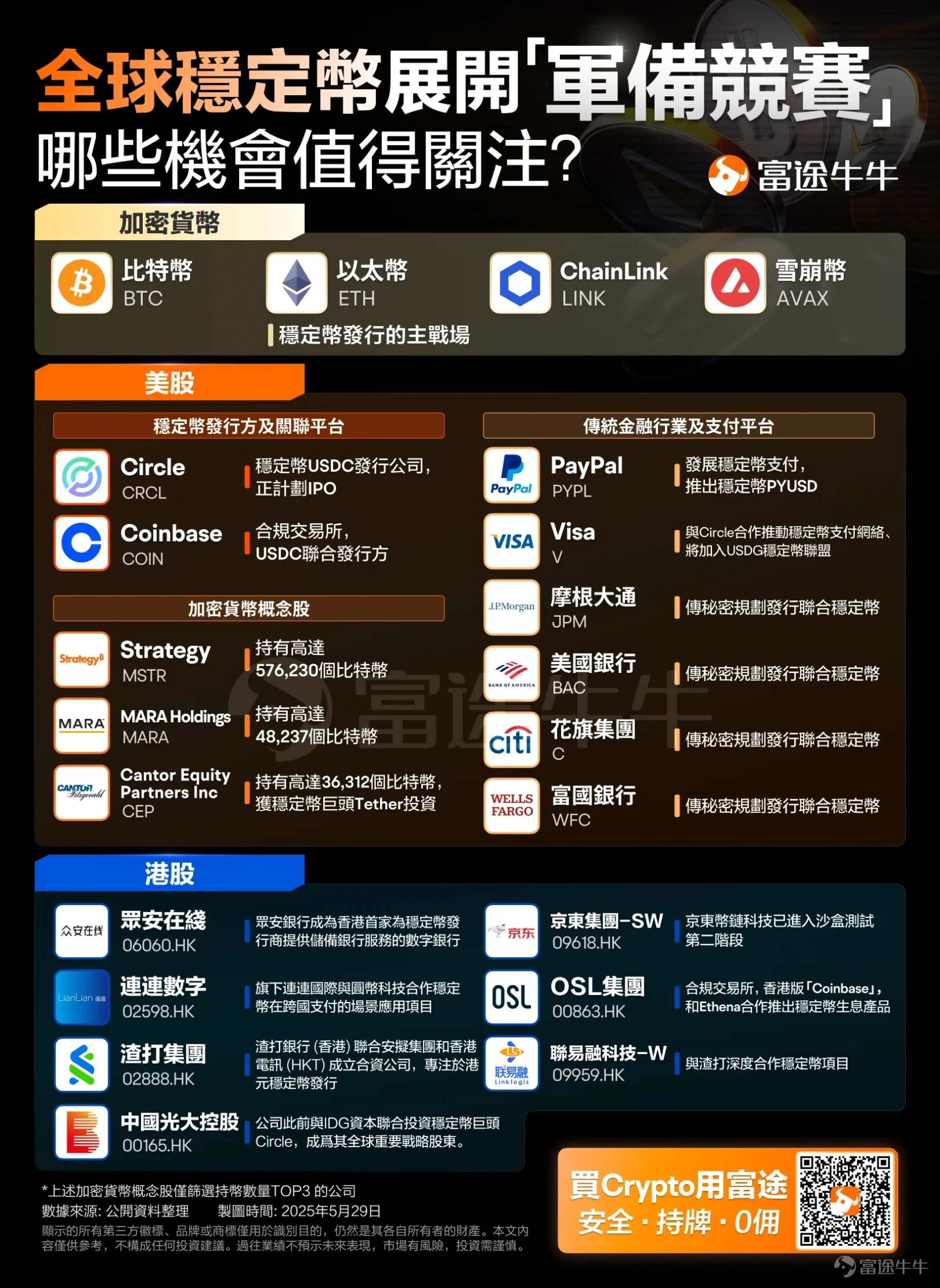
What is a stablecoin investment strategy
Short term: Focus on Circle's IPO and crypto exchanges such as Coinbase, which will benefit from market growth after clear regulation.
Long-term: Invest in tech companies like Chainlink and Avalanche, and will their applications and value follow an increase as the RWA market expands?
Risk Warning: RWA may face technical vulnerabilities or liquidity shortages. Participants are advised to diversify their investments and keep an eye on regulatory dynamics.
Chief Analyst of Futu Securities Liang
(The author is a licensee of the Securities and Exchange Commission and its affiliates do not have any financial interest in the proposed issuer of shares)
