How to play virtual currencies?
How do you trade Ethereum? The latest guide to ETH and investment strategies.

What is Ethereum?
Ethereum was developed by a Canadian engineer, Vitalik Buterin, and launched in 2015, aiming to expand Bitcoin's functionality and open up more application scenarios through the operation of "smart contracts." Today, Ethereum is one of the most popular blockchain networks after Bitcoin.
Meanwhile, Ethereum employs the Ethereum Virtual Machine (EVM) to execute highly complex algorithmic code. Developers embed programming languages as models and write applications that run on it—known as "DApps"—thereby creating use cases on the network.
What is Ethereum (ETH)?
Ether (ETH) is the native cryptocurrency of the Ethereum blockchain. Investors can not only trade it as a virtual currency, but it also plays a crucial role in decentralized applications and smart contracts, such as paying transaction fees and various network charges. Currently, Ether is the second-largest cryptocurrency by market capitalization, trailing only Bitcoin.
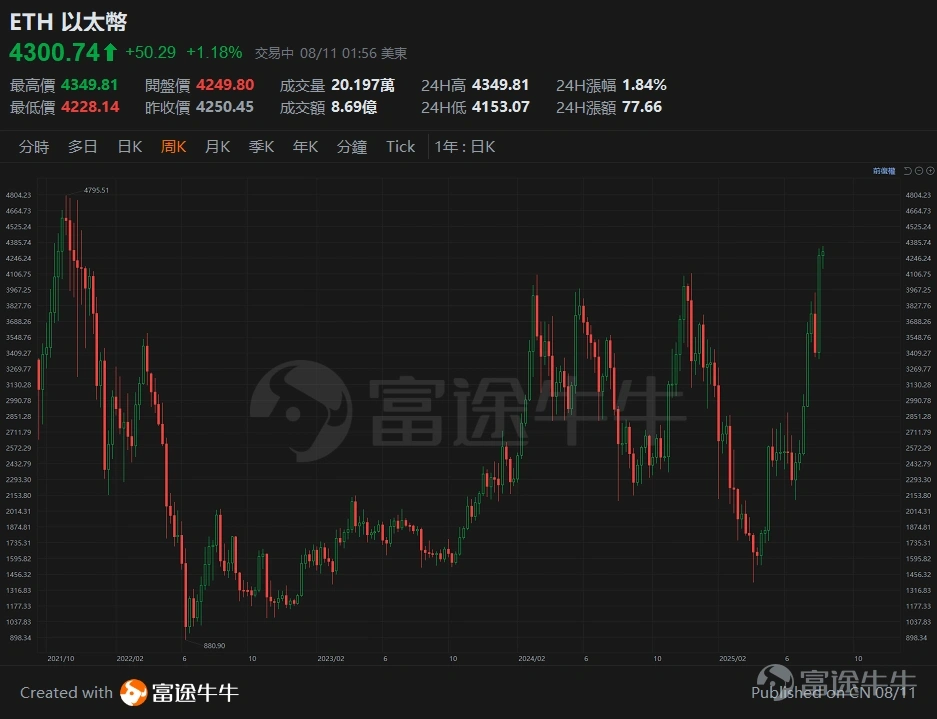
Ethereum Price Trend (August 2025)
Futu Securities Chief Analyst Tan Zhile (a licensed person with the China Securities Regulatory Commission, who and his associates do not hold any financial interests in the recommended share issuer) analyzes:
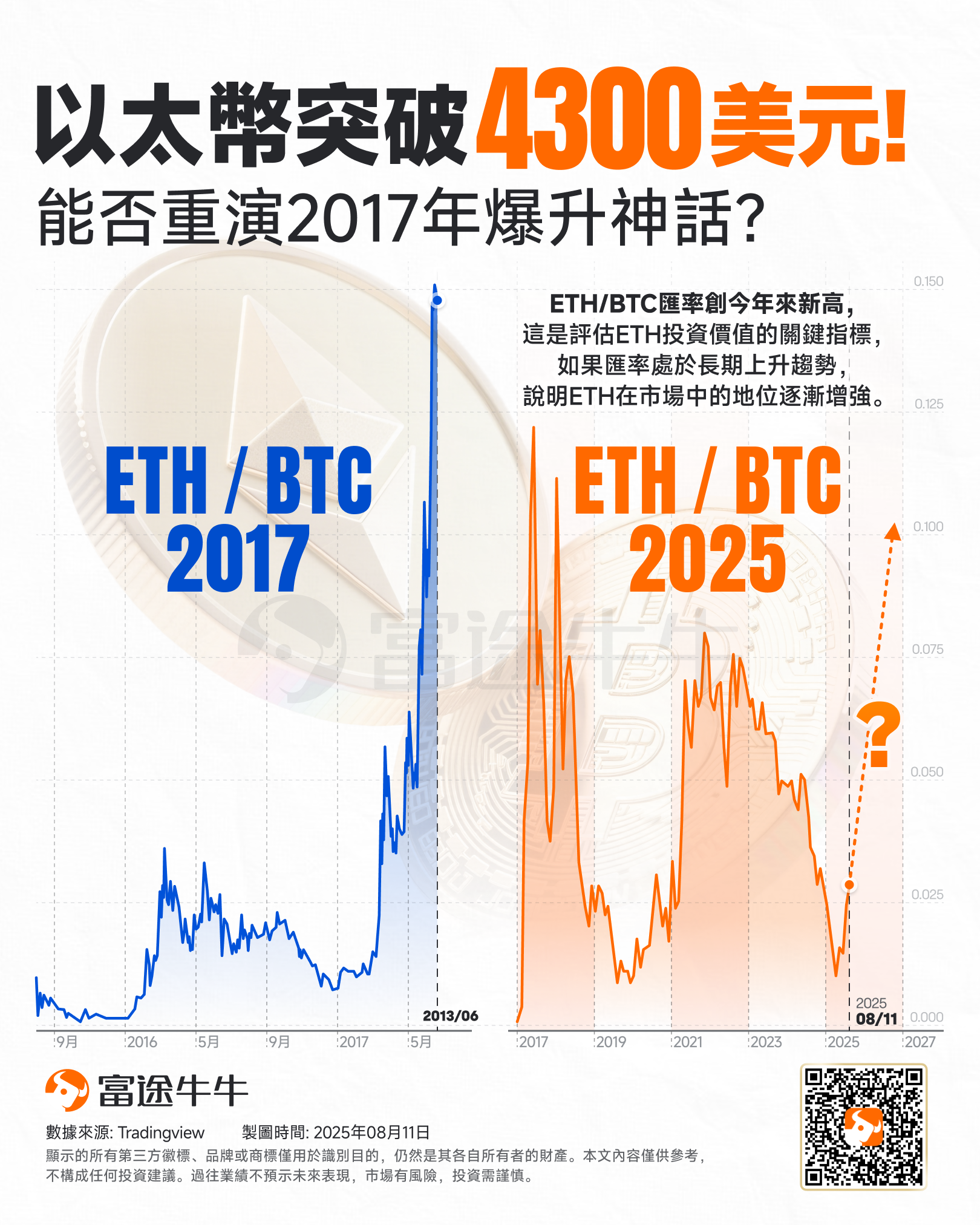
Recently, in the investment market, the cryptocurrency sector has attracted just as much attention as the Hong Kong stock market.$Hang Seng Index(800000.HK)$ $Hang Seng TECH Index(800700.HK)$or U.S. stocks$S&P 500 Index(.SPX.US)$ $Nasdaq Composite Index(.IXIC.US)$ 。 $Ether (ETH.CC)$Last week, prices hit a new year-to-date high, breaking above and holding steady above the $4,000 mark—the first time this has occurred on the weekly chart since 2022. From a technical perspective, the most prominent resistance level has now risen to an all-time high of $4,795.
In short, the renewed strength in Ethereum's price stems from…RWA tokenizationTrading interest has risen; since the U.S. began discussing the GENIUS Act in the second quarter of this year, market expectations for institutional adoption accelerating DeFi innovation have continued to strengthen. This has driven up market expectations for ETH demand, as tokenized trading relies on Ethereum's infrastructure. Moreover, Ethereum's Layer 2 solutions, such as Arbitrum, reduce transaction costs, enhance tokenization efficiency, and bolster the ecosystem's appeal. ETH serves as the payment for gas fees and the ecosystem's core asset.
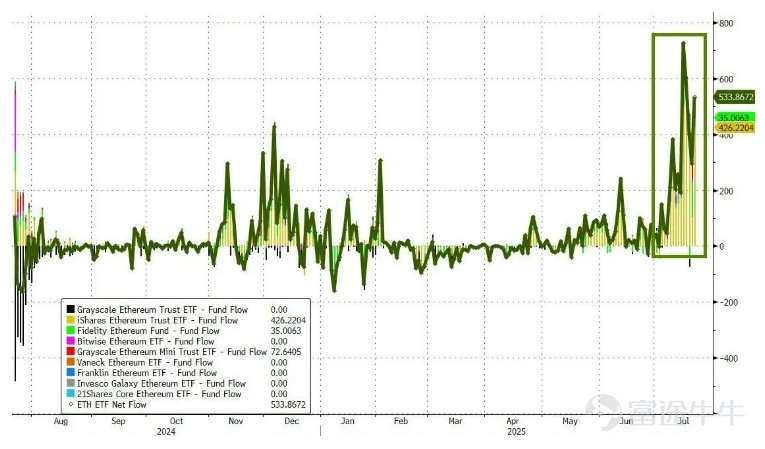
The anticipated increase in demand has also prompted substantial capital inflows into Ethereum‑based ETFs, driving Ethereum's price up by 48.9% in July alone. For more details, please refer to "Ether spot ETFs are attracting strong inflows: net inflows have continued for 13 consecutive days, with total assets under management surpassing $4 billion.」。
The differences between Ethereum and Bitcoin
Compare Items | Ether | Bitcoin |
Release date | 2015 | 2009 |
Main purpose | Supports smart contracts and decentralized applications (DApps) | Decentralized digital currency |
Consensus mechanism | Originally based on PoW, it has now been upgraded to PoS. | Proof of Work |
Block time | About 15 seconds | About 10 minutes |
Supply cap | No fixed upper limit | 21 million pieces |
Main uses | Smart contract computation fees | Investment |
Technical Foundation | The Ethereum Virtual Machine (EVM) supports smart contracts and DApps. | Blockchain technology, used for value transfer |
What is the price trend of Ethereum (ETH)?
To gauge whether Ethereum still has room to rise, its price trend over the past year shows an 85% gain. Coupled with news of Donald Trump's potential return to the political stage, this has been a significant boost for cryptocurrencies, and the market remains broadly optimistic about its outlook.
In addition, you can also keep an eye on two major trends:
1. Technological Upgrade
Ethereum's technology continues to evolve; once criticized for issuing roughly 18 million ETH annually, the network underwent an upgrade to Ethereum 2.0 in 2022, drastically reducing its issuance. Coupled with the introduction of a deflationary mechanism that burns ETH, this has conferred a degree of scarcity.
Therefore, the Ethereum Foundation later formulated the Ethereum 2.0 upgrade plan.
2. Ecosystem
Ether boasts one of the world's largest and most active developer communities. Thanks to its smart-contract capabilities, flexible development environment, and extensive resource support, Ether has attracted a vast number of developers to build and deploy diverse applications on its platform, including NFTs and in-game assets.
Is Ethereum (ETH) worth investing in?
Ethereum has grown rapidly and has long been regarded as the second-largest cryptocurrency since its inception. Despite its significant price volatility—with a five-year volatility rate of 84%—historical data indicate that its value and store-of‑value characteristics have continued to strengthen.
The annual price low of Ethereum | Price (USD) |
2024.1 | 2202.18 |
2023.3 | 1433.07 |
2022.6 | 988.62 |
2021.2 | 860 |
2020.3 | 97 |
2019.1 | 116.09 |
2018.12 | 82.83 |
2017.1 | 7.91 |
Moreover, in recent years, the market has begun to question the ability of fiat currencies to preserve value, with concerns that excessive money printing is underway. As a result, high‑risk, high‑return cryptocurrencies have, by extension, emerged as investment vehicles capable of preserving purchasing power.
How do you trade Ethereum (ETH)?
As mentioned above, Ethereum has a wide range of use cases, making its investment opportunities equally diverse. For instance, in the realm of decentralization, investors can earn rewards by staking, participate in DeFi liquidity mining, or trade NFTs. However, if we focus on more beginner-friendly or traditional investment approaches, there are three main options:
Spot trading of Ethereum
In spot trading, you directly hold Ether and profit by buying low and selling high. The strategy is straightforward, with no risk of liquidation—though returns tend to be relatively modest.
Ether Perpetual Contract
You can also trade perpetual contracts. These are a special type of derivative with no expiration date; as long as they are not forcibly liquidated, investors can hold the position indefinitely. However, given the extreme volatility of cryptocurrency prices and the fact that you can use leverage to amplify both returns and risks, margin calls—and even liquidation—can occur easily. Therefore, it's essential to set stop-loss orders. In Hong Kong, at present, such trading has not yet been approved by the Securities and Futures Commission.
Ether ETF
Since the U.S. Securities and Exchange Commission (SEC) approved the listing of Bitcoin spot ETFs in early 2024, nine more Ethereum (ETH) spot exchange-traded funds (ETFs) have been approved for listing this year. Among them, the Ethereum ETFs listed on the U.S. stock market include:
21Shares Core Ethereum ETF (CETH):$()$
Grayscale Ethereum Mini Trust (ETH):$Grayscale Ethereum Mini Trust(ETH.US)$
iShares Ethereum Trust (ETHA):$iShares Ethereum Trust ETF(ETHA.US)$
Franklin Ethereum ETF (EZET):$Franklin Ethereum Trust(EZET.US)$
VanEck Ethereum ETF (ETHV):$VanEck Ethereum ETF(ETHV.US)$
Bitwise Ethereum ETF (ETHW):$Bitwise Ethereum ETF(ETHW.US)$
Fidelity Ethereum Fund (FETH):$Fidelity Ethereum Fund(FETH.US)$
Invesco Galaxy Ethereum ETF (QETH):$Invesco Galaxy Ethereum ETF(QETH.US)$
Grayscale Ethereum Trust (ETHE):$Grayscale Ethereum Trust(ETHE.US)$
Investing in an Ethereum spot ETF does not involve holding Ethereum directly; instead, investors hold shares of the ETF, which tracks the price performance of a basket of Ethereum or an index. This allows investors to gain exposure at a lower cost, with relatively reduced volatility. Additionally, trading Ethereum in Hong Kong is open to retail investors, not just professionals.
How to Trade Ethereum (ETH) in Hong Kong
To trade cryptocurrencies such as Ethereum, the most important thing is to choose a secure, licensed brokerage or banking institution.
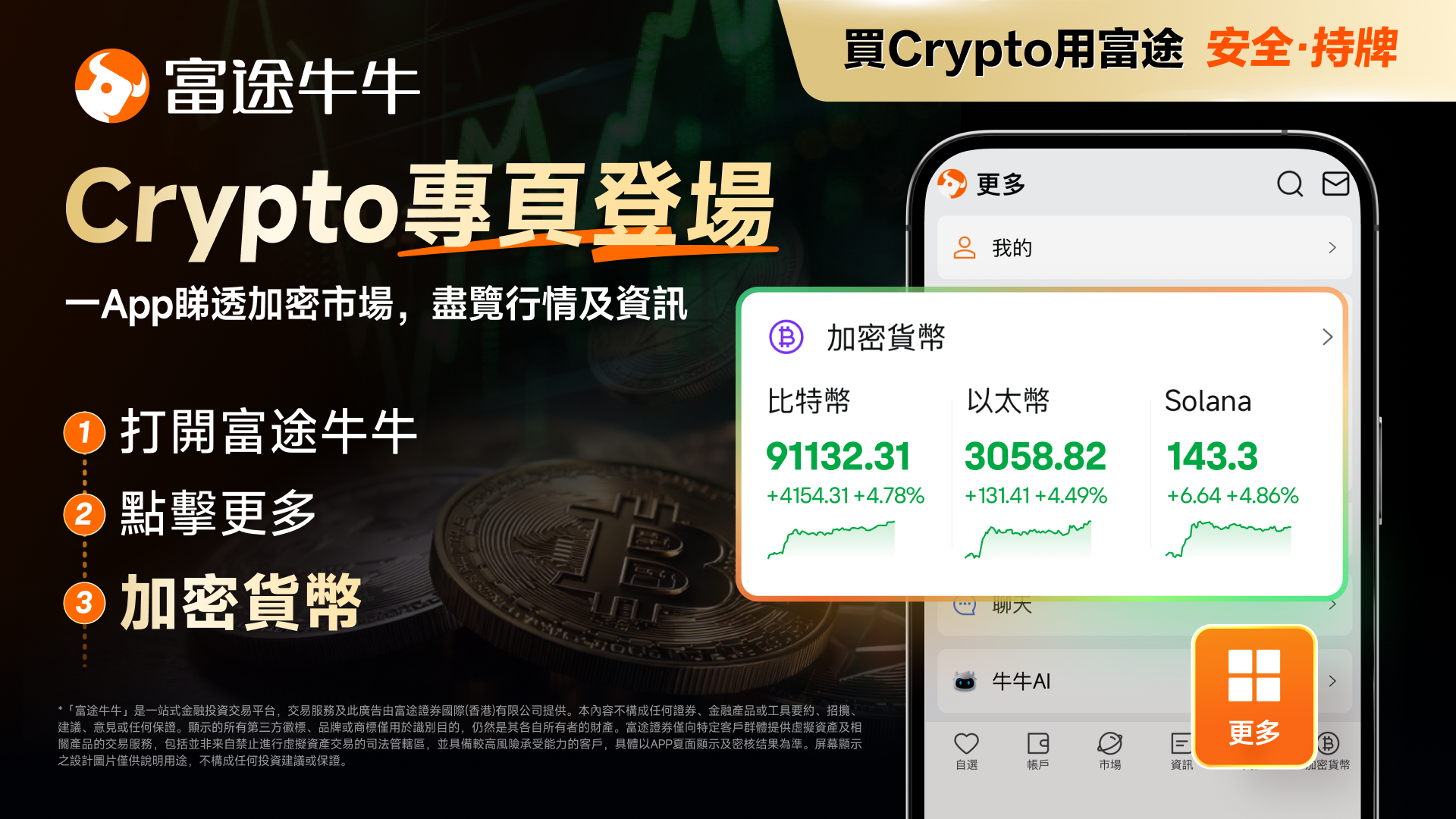
Not only can you trade cryptocurrencies, cryptocurrency spot ETFs, futures ETFs, and related concept stocks, but Futu also offers fiat currency trading, so users don't need to purchase USDT—they can directly use Hong Kong dollars or U.S. dollars to buy Bitcoin and Ethereum spot.
*Offers are subject to terms and conditions.
How to trade Ethereum through Futu
After opening your account, enable the crypto trading feature by going to the "Account" page, tapping "Cash Comprehensive Account," and then selecting "Account Management" under "More." Immediately activate the trading products, and then go to the "Not Activated" section to select "Cryptocurrencies."
Before you can activate a cryptocurrency account, you must complete a "Virtual Asset Risk Assessment, Virtual Asset Position Limit Assessment, and Virtual Asset Knowledge Test," as well as identity verification. After submitting your application, the activation process typically takes about five minutes; upon successful activation, you will receive a system notification and an email.
Before trading cryptocurrencies, please allow time to deposit funds into your crypto account. Go to the "Account" page, click "Cash Comprehensive Account – Cryptocurrencies," select "Fund Transfer" or "Deposit Funds," then choose the currency type and enter the amount. Once the funds have been credited, you can begin trading.
Go to [Market] - [Cryptocurrencies], select the currency pair you wish to trade, tap "Trade" in the lower-left corner, and you can start buying or selling. (How to trade cryptocurrencies on Futubull)
If you're interested in investing in an Ethereum ETF, simply search for "Ethereum ETF" to explore more cryptocurrency ETFs. You can also visit the ETF page to learn about each fund's asset size and key details, such as management fees and dividend policies, to help inform your investment decisions.


Futu Launches BTC, ETH, and USDT Deposit Functions
Futu has officially launched deposit services for Bitcoin (BTC), Ethereum (ETH), and Tether (USDT)*. Eligible investors can deposit funds and trade cryptocurrencies ("Crypto") through the one-stop trading platform Futubull, gaining access to a broader range of asset classes or withdrawing funds securely. With a single app, investors can seamlessly navigate both Crypto and TradFi assets—traditional financial assets including Hong Kong, U.S., and Japanese stocks, options, ETFs, mutual funds, bonds, and more—quickly switching between virtual and traditional markets, selecting suitable investment products to manage market volatility and ride out both bull and bear cycles.
*Limited to Professional Investors (PI) only.
How do I top up my cryptocurrency account?
Click "Account," then select "All – Cryptocurrency – Deposit." Follow the system prompts to enter the total deposit amount and the deposit address generated by the system, and use your existing personal cryptocurrency wallet to initiate the transfer and complete the deposit verification. Typically, the funds will be credited within 24 hours.