US Election | Trump Deal
What about CPI (Consumer Price Index) data? Latest comments for April
Author: Chai Chai (Chief Analyst of Futu Securities)
Recent market conditions have been volatile in both US and Hong Kong stocks, largely unaffected by the news of the Sino-US tariff trade war. The United States imposed a 104% tariff on China when the news was announced, and the “black period IG” outside the market fell further to 18657 points. , $Hang Seng Index(800000.HK)$ Following the market opening this morning, the index rebounded from a low of 19260 points, as the market's policies and domestic consumer spending took hold. The Hang Seng Index followed the traditional 250-port Bulldog Branch Line, and the shape of a broken foot technically emerged. The oscillation is larger $Hang Seng TECH Index(800700.HK)$ It's the same size.
In contrast, US stocks fell back after yesterday's highs, $S&P 500 Index(.SPX.US)$ It has a definite meaning. The Minimum Code Index does not fall into the technical boom area. As described above, the S&P 500 Index refers to 4917 as a weak line in the short term. Same place, $Dow Jones Industrial Average(.DJI.US)$ The 36000 point is an important defense line in the “technical bear city” area. $Nasdaq Composite Index(.IXIC.US)$ und $NASDAQ 100 Index(.NDX.US)$ Reason is also circumstantial.
Hong Kong stocks or US equities have recently returned to normal volatility, largely dependent on the trade war and the development of Sino-US relations, which are largely dominated by Trump. It makes sense now to judge whether the market is bottoming out or whether it will go down again, and to predict whether the trade war and the two countries' relations will ease or become more tense.
Impact of CPI on the market
The US CPI data published in April will be extremely important and may affect the state of the non-US economy and the downward impact on the real economy after the introduction of taxes. Significant Indicators of Disruption in relation to the Consolidated Balance Sheet.
Correlation of CPI to Debt Market Rates: Debt & Interest Rates Rising?
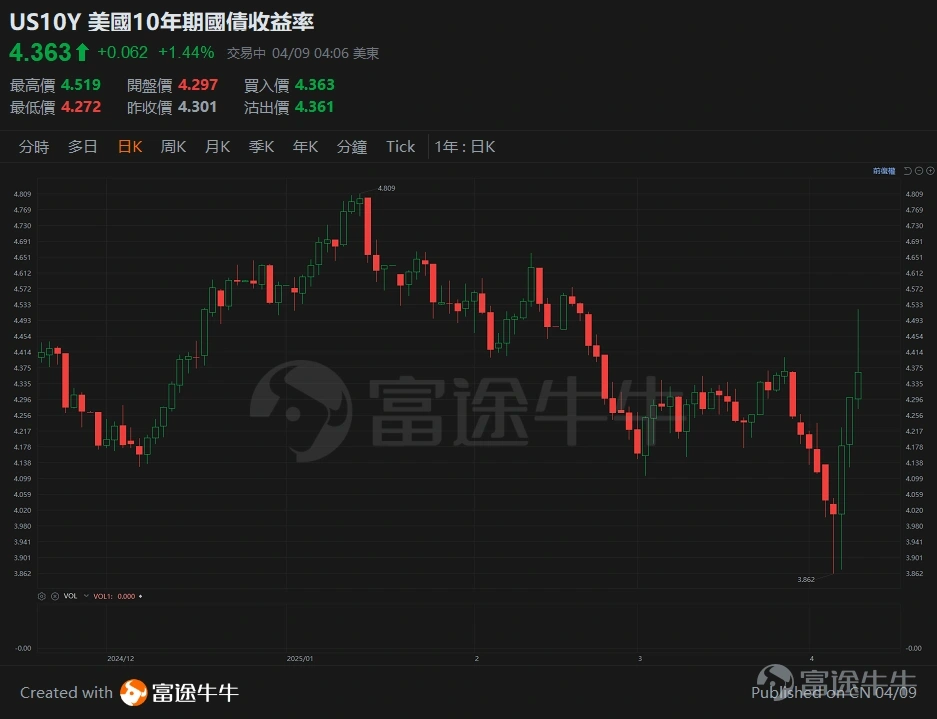
As the markets reacted to the economic downturn and risk sentiment was easing, the US 10-year debt was expected to rise sharply in the coming year. Ending a snap count, the short ended 3 Trade Days with 3.87 left and right to rise more than 60 basis points to 4.51. THE RETRACTION OF THE NEWS DOES NOT REFLECT THE MARKET'S GRIP ON THE U.S. PUBLIC. Beyond that, as the U.S. economic environment and trade relations become more complex, the risks of credit restrictions may reverberate into the investment price of sovereign debt. The US bond market has changed its relationship with international society, and the US debt sell-off is another market rout. This is another key reason why the market is moving closer.
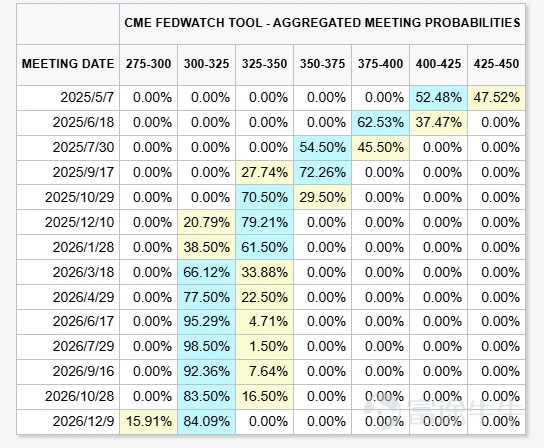
Aside from the above policy and trade considerations, one important thing to note is the timing of Interest Rates.
(Source:CME FEDWATCH)
The stock market is moving in a similar way. According to investors who are concerned, the decline in the period near May 7 is not expected to fall by about 50~ 62% on the day. The market does not care about the separation of interest rates in the short and long term, mainly due to the market turmoil related to taxes and the long term of the US economy Remote video. As you can see in the April 7 article, the market's forecast temperature drop in the long term for long-term interest rate declines in the two days is another guide to how long the debt rate will rise. The market forecast for the United States is not higher, the risks of the downgrade or are comparable to the stronger in 2022.
Why is the CPI performance on April 10 important?
Tariffs imposed after Trump took office may be reflected for the first time in CPI data, especially in manufacturing and consumer goods prices. The data will reflect the impact of tariffs, thereby determining the consequences of additional duties. The core CPI ratio is expected to grow at 0.3%, widely regarded by the market as a “tipping point”. If the actual value is higher than expected, it could raise market concerns about the Fed's continued high interest rate policy and even reduced room for future rate cuts. At this time, the US debt may be sold again.
Over the years, the cost of Energy and Transportation has been the main driving force behind Qualcomm's rise. Oil prices are expected to rebound in the near term, and due to certain taxes and labor costs, the resulting pressure will have to be removed in the short term, and all the pressure will be reversed in the short term.
CPI data are likely to reflect the current inflation-plagued state of the United States, coupled with the recent surge in debt that has sent U.S. residents” mortgage or car interest rates soaring, and their cost of living will greatly increase. The CPI data is very likely to be a fire line for US residents' discontent, and Trump's tariff policy will face greater public pressure.
So it is impossible to simply look directly at the pros and cons of the high lows that followed the rise of this data, as the case shows, that there is a reason for the lack of clarity in the general public. The best way to do this is to trade the position after the data is heated. Now, before the data comes out, it is important to anticipate and monitor the future development of trade wars and tariffs.
After-market strategy proposal
At the moment, the way people look at the aftermarket is not very pleasant. Maintaining the trend of audit activity on the Hong Kong stock market, it is possible to continue to consider consumption costs in the short term. In US stocks, the issue of higher valuations is important, but if some of the Tech Industry's valuations are based on stocks that are stable in cash flow, it is not possible to recoil well after position.
Consumption Expense Sector: $HAIDILAO(06862.HK)$ $ANTA SPORTS(02020.HK)$ $POP MART(09992.HK)$ $MENGNIU DAIRY(02319.HK)$ $CTG DUTY-FREE(01880.HK)$
US Equity Networking Sectors: $NVIDIA(NVDA.US)$ $Taiwan Semiconductor(TSM.US)$ $Broadcom(AVGO.US)$ $Meta Platforms(META.US)$ $Netflix(NFLX.US)$
The following are the key strategies to be adopted in the market today:
Trade with high value ratios is easy for anyone to use the stop function of cattle from short line angles
The options strategy is applicable to the risk of falling, for example, the strategy applies to the risk of a cold, for example, if the Sell option is to trade (does not support the sell), the target is to buy the options fund of the floating market (does not support the sale,) the target is to take the options funds of the floating market
$CBOE Volatility S&P 500 Index(.VIX.US)$ und $HSI Volatility Index(800125.HK)$ Use only as a hedge, primarily to guard against black swan events. It is not recommended at the current level to trigger “disaster fortunes”
Currently, any Buy Sell Strategy is a short line, all short lines will be calculated in units within hours
The market should not be oversold, but falling to current levels should not be overly pessimistic. Most importantly, investment diversification
The author is a licensee of the Securities and Exchange Commission and its affiliates do not have a financial interest in the Proposed Share Issuer
