[Bond Investment Guide] How to Buy Bonds in Hong Kong?
[Bond Investment Guide] How can you conveniently buy bonds in Hong Kong?
"Are bonds right for me? What are the key differences between investing in bonds and stocks? How should I invest in bonds?" If you're considering bond investments but still have these questions, this article will provide a quick overview of bond fundamentals and help you get started with bond investing.
What is a bond?
A bond is a debt instrument issued to raise capital. The entities that issue bonds are typically governments or corporations. In other words, investing in bonds is akin to lending money to the issuing government or corporation. After purchasing a bond, the issuer is obligated, as agreed, to repay the principal amount—equal to the bond's face value—at maturity and to make regular, fixed interest payments to the bondholder until maturity.
The defining feature of bonds is the obligation to repay principal and pay interest, which is why they are also referred to as "fixed-income assets."
Advantages of Bond Investment
Stable returns
Although equities offer potentially high returns, choosing the wrong securities or timing your trades can still lead to losses; no publicly listed company guarantees principal. By contrast, if a bond is held to maturity, the issuer is obligated to repay the principal and pay the agreed‑upon fixed interest.
More secure
If a company is liquidated due to operational difficulties, bondholders can recover a portion of their invested capital from the liquidated assets prior to shareholders, thereby enjoying relatively greater protection of their equity. It should be noted, however, that if the company is already insolvent, even creditors may not be able to secure full repayment of their claims.
Bonds and stocks are negatively correlated.
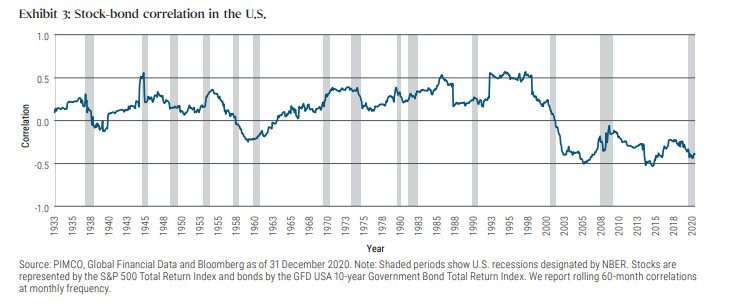
Research data (source: The Discreet Charm of Fixed Income, PIMCO) show that, although the correlation between U.S. equities and bonds has fluctuated over the period 1933–2020, since 2000 it has remained below zero for most of the time. This implies that when the stock market as a whole is under pressure, bond yields are likely to trend upward.
If stocks and bonds continue to exhibit a negative correlation, investing in both asset classes simultaneously can help smooth out the returns of your portfolio.
Risks of Bond Investments
Investing in stocks makes you a shareholder of the listed company, exposing you to the risk of share price declines due to adverse company‑specific or market factors. By contrast, bondholders become creditors of the government or a corporation, with default risk—i.e., the risk that the issuer fails to repay principal and interest on time—as their primary concern. Consequently, the creditworthiness of the issuer is of paramount importance, and investors should prioritize issuers with relatively high credit ratings.
Bond investments require attention to six key factors.
Issuing entity: The national or regional government, corporation, or other entity that issues bonds—i.e., the "borrower."
Bond par value (principal): Also known as the face value, it refers to the amount that the bond‑issuing entity repays to the bondholder upon maturity. Simply put, it represents the "amount borrowed."
Maturity Date: The period during which the bond is valid, with bonds having no maturity date classified as "perpetual bonds."
Coupon Rate: The interest rate (annualized) agreed upon by the issuer to be paid to bondholders.
Dividend Payment Date/Frequency: The date or frequency of dividend payments as specified by the bond issuer (annually, semi-annually, quarterly, or monthly).
Bond price: the cost of purchasing a bond; note that bond prices are influenced by factors such as interest rates and may not equal the face value, potentially resulting in a premium or a discount.

How is bond interest calculated?
How do you calculate the interest earned per period during the holding period of a bond? The calculation formula is as follows:
Each interest payment = Coupon rate ÷ Frequency of payments × Bond face value
For example, suppose Mr. Zhang purchases a bond issued by ABC Company with a face value of 10,000 yuan, paying interest semiannually at a coupon rate of 5%, with a maturity of 5 years, and issued at par. How much in total interest will Mr. Zhang receive when the bond matures after 5 years?
The answer is: (5% ÷ 2) x 10000 x 10 = 2500
The bond pays interest twice a year, for a total of 10 payments over five years. As a result, Mr. Qiang receives 250 yuan in interest each period (every six months). Over the holding period, he thus earns 2,500 yuan in interest. Upon maturity, the issuer repays the principal; therefore, if Mr. Qiang holds the bond for five years, he will receive a total of 12,500 yuan.
What types of bonds are there?
Based on the bond's maturity date, issuer, and credit rating, it can be classified into the following categories:
By maturity date:
They are classified as long-term bonds or short-term bonds. Generally, the shorter the maturity of a bond, the lower its interest-rate risk and the greater its certainty, which is why its yield tends to be relatively lower.
By Issuer:
They are categorized into government bonds and corporate bonds. Generally, government bonds are safer than corporate bonds, particularly in countries or regions with strong economic fundamentals and high levels of development, such as U.S. Treasury bonds. Certain third-party rating agencies assess the creditworthiness of governments and corporations across different jurisdictions; bonds issued by entities with higher ratings are considered correspondingly safer.
By risk rating:
They are divided into investment-grade bonds and high-yield bonds (also known as junk bonds). According to the rating standards of agencies such as Moody's, S&P, and Fitch, bonds rated BBB or higher, or Baa or higher, are classified as "investment-grade bonds," which are generally relatively safe but offer lower yields; bonds rated below these levels are referred to as "high-yield bonds" or "junk bonds," which carry a higher risk of default and typically offer higher yields.
How do Hong Kong investors invest in bonds?
For Hong Kong investors, while the range of bond options is less diverse than that of equities, it can still broadly meet investment needs. Most Hong Kong bond investors prefer bonds with high credit ratings, such as government bonds and U.S. Treasury securities.
Common government bonds are categorized into two types: listed and unlisted. The key difference is that listed bonds, in addition to being available for subscription, can also be bought and sold on the stock exchange, much like stocks; whereas unlisted bonds can only be traded through designated banks or brokers.
Inflation-Linked Bonds (iBonds)
iBond is an inflation-linked bond issued by the Hong Kong Government to all Hong Kong residents. Taking the iBonds issued in 2021 as an example, the minimum denomination is HK$10,000, with a term of three years and semi-annual interest payments at an annual rate of at least 2%. These bonds can be traded on the stock exchange.
Silver Bond
Silver BondThese are bonds issued by the Hong Kong Government specifically for senior citizens, designed to provide elderly residents with a safe, low‑risk investment option that delivers stable returns. They were first launched in 2016. Taking the 2023 issue as an example, the minimum denomination is HK$10,000, with a term of three years and interest paid semiannually. Eligibility is limited to individuals aged 60 or above. Silver Bonds cannot be traded on the stock exchange but may be redeemed from the government at any time.
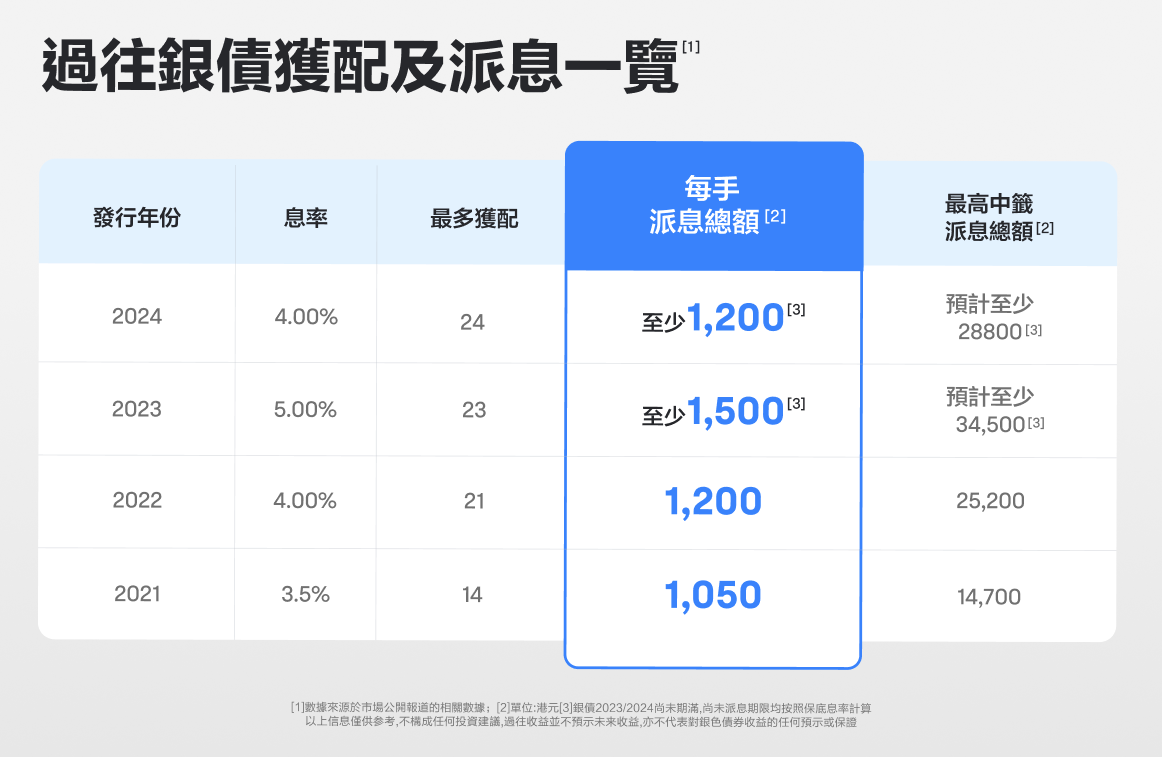
In 2026, the Hong Kong Government announced the launch of a new batch of silver bonds, which have recently opened for subscription. For further details, please refer to…Government Notice. The allocation and dividend information for previous years is as follows:
Government Sustainable Bonds (Green Bonds)
Government Sustainable Bonds (also known as Green Bonds), issued by the Hong Kong Government, primarily aims to raise funds to finance green projects that meet specified eligibility criteria. These bonds were first publicly offered in 2022; taking the 2023 green bond as an example, the minimum denomination is HK$10,000, with a tenor of three years, semi-annual coupon payments, and a minimum annual coupon rate of 4.75%. They are tradable on the stock exchange. All individual investors holding a valid Hong Kong Identity Card are eligible to subscribe.
Infrastructure bonds
Infrastructure construction bonds (referred to as infrastructure bonds)It is a new initiative launched by the Hong Kong Government in the 2023–2024 Budget, aimed at supporting infrastructure development. Funds raised through the issuance of these bonds will be allocated to the Government's Capital Works Reserve Fund, which will finance a range of large-scale infrastructure projects, including port and airport expansion, building works, drainage systems, civil engineering, road networks, as well as the development of new towns and urban areas.
Starting November 26, 2024, government infrastructure bonds will be available for subscription to Hong Kong residents, with a target issuance size of between HK$20 billion and HK$25 billion. Each bond lot has a face value of HK$10,000, a term of three years, and pays interest semi-annually. The coupon rate will be adjusted in line with local inflation, but the minimum annual interest rate is guaranteed at 3.5%.
Airport Authority Retail Bonds
Airport Authority Retail Bonds(Airport Management Bonds) are issued by the Airport Authority Hong Kong, with proceeds earmarked to finance airport development projects, upgrade infrastructure, or cover other operational expenses. (The Airport Authority Hong Kong is a statutory body owned by the Government of the Hong Kong Special Administrative Region, responsible for the operation and management of Hong Kong International Airport.)
Take the AAHK bonds issued in 2024 as an example: the minimum denomination is HK$10,000, with a tenor of 2.5 years, a coupon frequency of once every three months, and an annual coupon rate of 4.25%. These bonds are listed on the stock exchange and are available for subscription to all investors holding a Hong Kong Identity Card.
U.S. Treasury Bond
As the name suggests,U.S. Treasury bondsThese are bonds issued by the U.S. government, which can be traded by both institutional and individual investors worldwide. U.S. Treasury securities are typically rated with the highest credit rating by rating agencies, making them among the most liquid bonds globally and widely regarded as one of the "safest assets."
U.S. Treasury securities are primarily categorized by maturity into three types: short-term (within 1 year), medium-term (1 to 10 years), and long-term (over 10 years). Interest rates on U.S. Treasuries vary depending on the maturity and the specific date of maturity.
How do you buy U.S. Treasury bonds?
In the Futubull app, you can find U.S. Treasury bonds in just a few simple steps.Invest in U.S. Treasury bonds through Futu, with an entry threshold starting at $1,000.
Click "Wealth Management" and select "Bonds."
On the "Bonds" page, you can browse bonds by category on the homepage.
Click "U.S. Treasury Bonds" to view the list of bonds supported for trading by Futu; click the filter in the upper-left corner to further refine your search by specific criteria.
Click on a specific bond to view the latest bid and ask prices as well as its historical price trends.

Don't want to buy bonds directly? You can also invest in bond ETFs.
In addition to directly purchasing bonds, investors can also invest in bonds through ETFs.
Relatively speaking,Bond ETFThe biggest advantage is that investors can avoid the hassle of selecting individual bonds and, at low cost, hold a diversified portfolio of bonds, thereby achieving effective diversification.
However, bonds and ETFs are fundamentally two entirely different asset classes: bonds have a fixed maturity, whereas ETFs do not. The institutions that manage ETFs periodically replace maturing bonds in their holdings with newly issued ones.
