Latest US Stock Analysis | How should investors deploy?
[CTA Strategy] The hidden driver of short-term market risks in US stocks with the latest analysis and coping strategies
US stocks fell sharply yesterday, $ S&P 500 Index (.SPX.US) $ 、 $Nasdaq Composite Index(.IXIC.US)$ 、 $Dow Jones Industrial Average(.DJI.US)$ Further evaporated the rebound that emerged last Friday. On the daily chart of technical analysis, the three major indexes are showing a “break-even” pattern. In fact, the situation is indeed not as optimistic as cryptocurrencies that reflect high-risk assets are being sold.
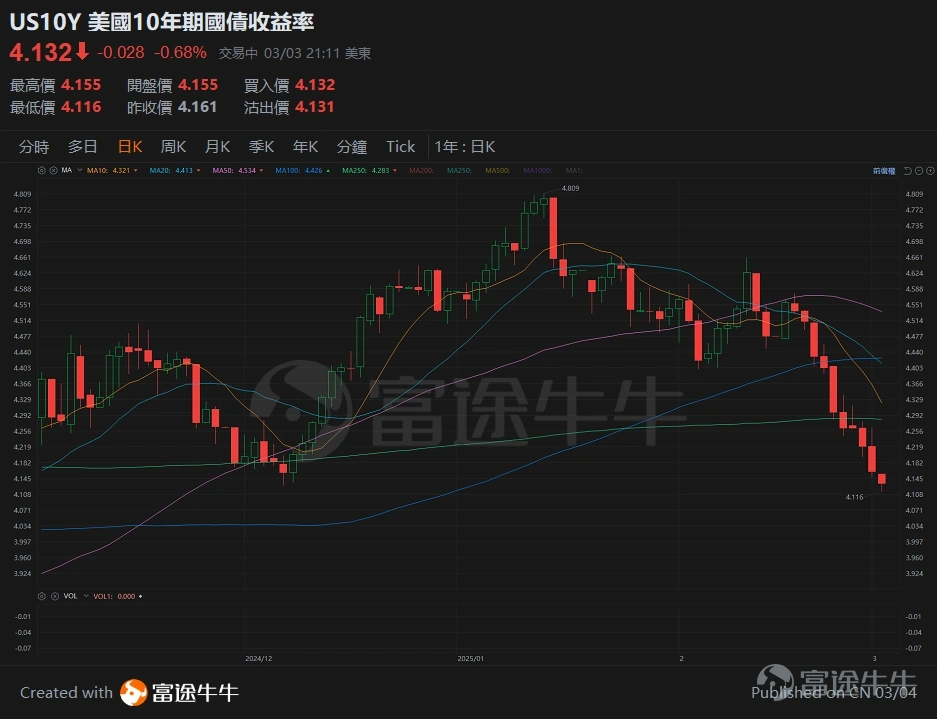
Trump brought major uncertainties in tariff trade and international relations, driving market risk-averse sentiment higher, while interest rate cut expectations strengthened and led to a decline in debt. In the context of strong risk-averse sentiment, risk assets are falling almost all over the line, especially the recently popular topic of AI investing, where semiconductors, robots, AI healthcare, drones and more have become major disaster zones in the fall market.
eg $NVIDIA(NVDA.US)$ $Taiwan Semiconductor(TSM.US)$ $Tesla(TSLA.US)$ $Serve Robotics(SERV.US)$ $Tempus AI(TEM.US)$ $Recursion Pharmaceuticals(RXRX.US)$ $Hims & Hers Health(HIMS.US)$ $Advanced Micro Devices(AMD.US)$ $Super Micro Computer(SMCI.US)$ $Intel(INTC.US)$
The author is not sure about the short-term aftermarket either, but today mainly wants to share some basic investment knowledge. The US stock market is facing a wave of adjustment pressure, with market volatility intensifying and investor sentiment becoming cautious. One thing you need to know is that the role of Commodity Trading Advisors (CTAs) cannot be ignored.
AS AN INSTITUTION THAT RELIES ON PROGRAMMATIC TRADING, THE CTA'S BEHAVIOR CAN INCREASE DOWNWARD PRESSURE ON THE MARKET IN THE SHORT TERM AND BECOME A POTENTIAL SOURCE OF RISK. This article will delve into what a CTA is, analyze its impact in the current US equity market, and why it may be a key factor in market risk in the short term, in order to help investors understand this phenomenon and prepare for it.
What is a CTA?
COMMODITY TRADING ADVISORS (CTAS) ARE A CLASS OF PROFESSIONAL INVESTMENT MANAGEMENT AGENCIES OR INDIVIDUALS WHO PRIMARILY EARN INCOME BY MANAGING CLIENT FUNDS IN FUTURES, OPTIONS AND OTHER DERIVATIVES TRADES. CTAs typically adopt systematic, programmatic trading strategies that rely on algorithms and technical analysis to capture market trends, which are very different from traditional fundamental investing methods. As defined by the Commodity Futures Trading Commission (CFTC), a CTA is required to be registered with the CFTC and regulated by the National Futures Association (NFA).
The core strategy of a CTA is usually Trend Following, that is, to determine the direction of the market by analyzing price movements and establishing positions accordingly when the trend is established. For example, when the market goes up, the CTA may buy in bulk; when the market falls, it quickly sells or goes blank. This strategy is characterized by being highly dependent on momentum, and once a market trend reverses, the CTA quickly adjusts positions, potentially triggering large-scale trading behavior.
The CTA's managed assets are quite large. pursuantBarclayHedgeAccording to data, as of the end of 2024, the total assets under management of CTA worldwide exceeded $350 billion, of which the US market accounted for a significant share. The centralized operation of these funds allows the CTA's trading behavior to have a significant impact on market liquidity and price movements.
Current CTA Pressure in US Stocks
US stocks are at a key tipping point. The market is trending downwards under the influence of uncertainty over Trump's policies (such as tariffs and trade measures), technical signals (such as recent breakthroughs), and selling pressure on popular blocks such as AI-related stocks. Against this backdrop, CTA's programmatic trading may increase market pressure.
pursuantInvesting.comCTA may sell a lot of stocks when the market goes down, citing an analysis by Goldman Sachs. Data for January 2024 showed that the CTA could sell at least $2.9 billion in shares in a week, while in a more unfavorable case, the selling pressure could reach $24.3 billion. Going into 2025, the scale of this selling pressure is likely to expand further as market volatility intensifies.
Taking the S&P 500 Index (SPX) as of March 3, 2025, the price was around 5950 pips, down circa 4% from its mid-January high of 6200. This decline could trigger the CTA's trend-following strategy, leading to its massive downsizing of stock positions. pursuantMarketWatchIn the data, SPX has increased significantly in recent trading volume, which is consistent with the CTA's programmatic selling behavior.
CTAs can be a trigger for market risk in the short term, mainly for the following reasons:
1. Quick Reaction for Programmatic Trading CTA's trading strategy relies heavily on algorithms that automatically trigger a sell order when the market price falls below a key technical level, such as the neck line or moving average. This quick reaction mechanism helps capture trends when the market is flat, but can trigger chain reactions when volatility intensifies.
2. Momentary amplification effect The trend of the CTA follows that the strategy has the characteristics of momentum amplification. In a falling market, the selling behavior of a CTA can trigger panic selling by other investors, forming a vicious cycle. pursuantReutersMarket concerns about Trump's policies have led to an uptick in risk-averse sentiment, and selling pressure on the CTA may further amplify this sentiment.
3. Market liquidity pressure Mass selling of CTAs may lead to short-term tightening of market liquidity, especially during periods of high trading volume. When buyers decline and selling pressure increases, the price may accelerate its decline. Historically, rapid clearances of CTA have exacerbated market volatility during the “Volmageddon” of 2018, when the S&P 500 fell more than 10% in a matter of days.
4. Overlapping with other factors, the current market is facing not only the pressure of the CTA, but also the uncertainty of Trump's policies, bearish signals in the technical form, and the gain of the AI segment. These factors combine to make selling pressure on the CTA even more destructive in the short term. For example,DeloitteSemiconductor industry growth is forecast for 2025, but recent declines in stocks such as Nvidia may trigger CTA declines in tech stocks.
How do investors cope with CTA stress?
In the face of short-term market risks posed by CTAs, investors can adopt the following strategies:
Stay calm and avoid following a sell-off: CTA selling pressure is usually short-term and the market may return to stability in a few days or weeks.
Watch for technical support levels: Breaching these levels may trigger more selling pressure, such as the SPX's 5850p 3 first trading day candle bottom.
DIVERSIFIED INVESTMENT: ALLOCATE FUNDS TO DEFENSIVE BLOCKS (SUCH AS UTILITIES) OR NON-EQUITY ASSETS (SUCH AS BONDS) TO REDUCE VOLATILITY.
Take advantage of volatility opportunities: Of course, for experienced investors, CTA selling can create opportunities to buy low and even look for opportunities to capture premium stocks; but novice investors should try to avoid it as much as possible, or understand the ins and outs of the whole event before deploying.

Recent US Stock Analysis Conclusions
COMMODITY TRADING ADVISORS (CTAS) PLAY A KEY ROLE IN THE US EQUITY MARKET IN MARCH 2025 AS A KEY PLAYER IN PROGRAMMATIC TRADING. Its trend following strategy and mass selling pressure can amplify market downward pressure and become a hidden trigger for short-term risk. From the uncertainty of Trump's policies to the weakening of technical signals, to the adjustment of the AI component, the behavior of the CTA overlaps with these factors, intensifying market volatility. Investors need to understand how CTAs work, remain rational, and take appropriate risk management measures to steady their footing during this wave of adjustment and even look for potential opportunities.
Most importantly, many investors have recently been asking whether they can buy some popular AI blocks such as semiconductors, medical, robots, smart cars, etc., even if the fundamentals or the entire logic of long-term investing have changed, investors should still be concerned about the risks associated with a short line spike.
Chief Analyst of Futu Securities Liang
(The author is a licensee of the Securities and Exchange Commission and its affiliates do not have any financial interest in the Proposed Share Issuer)
