Options Tutorial: From Beginner to Practical (Fundamentals, Trading Strategies, Hands-On Skills)
Covered Call: Earning "rent"/option premium income

Covered Call: Earning "rent"/option premium income
In the fast‑changing stock market, holding a high‑quality stock for the long term is a core strategy for many investors. But if your shares remain stuck in a sideways range or grow only slowly, those holdings can feel "stagnant." Have you ever wondered whether there's a way to generate additional cash flow from such positions while you wait for their value to appreciate? The answer is yes—and the Covered Call strategy is one effective approach that lets you earn "rent" in the form of option premiums.
What is a Covered Call?
A Covered Call (known in Chinese as "bèiduì kànzhuàng qīquán") is an options‑based investment strategy. Simply put, if you already own a particular stock—typically at least 100 shares—you can sell a call option contract to other investors in the market.
This strategy can be loosely compared to "renting out your shares." You're the landlord, and the shares you hold are the property. For Hong Kong investors familiar with the value of real‑estate investing, this analogy is particularly easy to grasp. By selling a covered call, you grant the buyer the right to purchase those shares from you at a specified price—known as the strike price—on a particular future date—the expiration date. In return, regardless of whether the buyer ultimately exercises that right, you immediately collect a fee, which in options terminology is called the "premium." This is an excellent way to generate additional income on top of your existing stock holdings.
How does the covered call strategy work?
To fully understand the covered call strategy, the best approach is to break it down through a complete trading example. Given that many Hong Kong investors trade U.S. stocks, let's take NVIDIA (NVDA), currently the highest‑market‑cap stock, as our case study. Suppose you're bullish on this leading AI‑chip company and bought 100 shares when the stock was trading at $130. Now, you'd like to generate some additional income from this position.
Your trade is to sell one call option contract on NVDA, with a strike price of $140 and expiration in one month. With this transaction, you immediately earn $400 in option premium—$4 per share.
One month later, when the option expires, one of the following three main scenarios will occur:
Screening logic: Among U.S. stocks, the stock with the largest market capitalization; data date: May 29, 2026.
Scenario 1: If the stock price falls below $140 (e.g., to $135), the option expires worthless.
The option buyer will not exercise the option (because the market price is below the strike price), and the contract expires worthless.
Hold 100 shares of NVDA, while retaining $400 in option premium as additional income.
Book profit on the stock holding: ($135 - $130) × 100 = $500
Total revenue: $500 + $400 = $900
Scenario 2: The stock price rises sharply (e.g., to $160) — the option is exercised.
If the option buyer exercises their right, you must sell 100 shares of NVDA at $140.
Your stock profit: ($140 - $130) × 100 = $1,000
Plus the option premium: $400
Total Revenue: $1,400
Cost: You missed out on a gain of over $140. If you had not sold the option, you would have earned ($160 – $130) × 100 = $3,000.
Scenario 3: Stock price declines (e.g., to $120) — the option expires worthless, but the stock position incurs a loss.
The option expires worthless, and you retain the $400 premium.
Book loss on stock holdings: ($120 - $130) × 100 = -$1,000
Option premium offsets part of the loss: -$1,000 + $400 = Net loss of $600
You lost $400 less than if you hadn't sold the option.
Understanding Covered Call Trading Step by Step
Let's organize the above process into a clear set of steps:
Underlying Asset Holdings: First, you must hold a sufficient number of the underlying shares. Note that one standard U.S. stock option contract represents 100 shares, which differs from the varied "lots per board" in the Hong Kong market. Therefore, when trading U.S. stock options, make sure to maintain holdings in multiples of 100 shares.
Analysis and Decision: You judge that the stock is unlikely to experience a significant short-term rally, expecting its price to trade sideways or rise moderately.
Selling a Call Option: In your securities account, select "Sell to Open" for a call option. You will need to choose an appropriate strike price and expiration date.
Option Premium Collection: Upon successful execution of the trade, the option premium will be credited to your account immediately, providing you with instant cash flow.
Expiration Pending: Before the expiration date, you may choose to hold the option until expiration, close the position early (by buying back the option), or roll it over.
Settlement: On the expiration date, whether your shares are exercised and sold will depend on the relationship between the stock price and the strike price.
Key terms: Strike price and expiration date
In a covered call strategy, selecting an appropriate strike price and expiration date is critical, as it directly impacts your potential returns and risks.
Strike Price: This is the price at which you agree to sell the stock.
Choosing a higher strike price means you anticipate greater upside potential for the stock. The advantage is that the stock is less likely to be exercised and sold, but the option premium you receive will also be relatively lower.
Choosing a lower strike price indicates a more conservative outlook on the stock's upside. You'll receive a higher option premium, but the risk of the stock being exercised and sold off is also greater.
Expiration Date: This is the final date on which the option contract remains valid.
Choosing a shorter expiration date (e.g., a few weeks) allows you to collect option premiums more frequently, making your strategy more flexible. However, the amount collected each time will be smaller.
Choose a longer expiration date (e.g., several months): You can collect a higher premium upfront, making the trade simpler to manage. However, your shares will be locked up for a longer period, and if the stock price experiences significant volatility during that time, you'll lose flexibility.
The Core Advantages of the Covered Call Strategy
Implementing a covered call strategy offers investors two key benefits, making it a highly regarded investment tool.
Generate additional cash flow income
This is the most straightforward and appealing advantage of covered calls. Regardless of whether the stock market rises or falls, by selling options you can immediately generate premium income. This approach aligns with the preference of Hong Kong investors to earn stable cash flows through dividends or property rentals. When the market is trading sideways or trending slowly higher, this strategy becomes especially valuable, putting your idle capital to work and generating additional "interest."
Reduce the cost basis of shareholdings
Each time you successfully collect option premium without the stock being exercised, that income effectively lowers your average cost basis for holding the stock.
For example, if you buy a stock at $50 per share and earn $2 per share in option premium through a covered call strategy, your effective cost basis drops from $50 to $48. Over time, this can significantly reduce your cost basis, meaning that even if the stock price declines slightly in the future, you may still remain in profit, providing a stronger margin of safety for your investment.
Open an options account with Futu and implement a cash flow strategy.
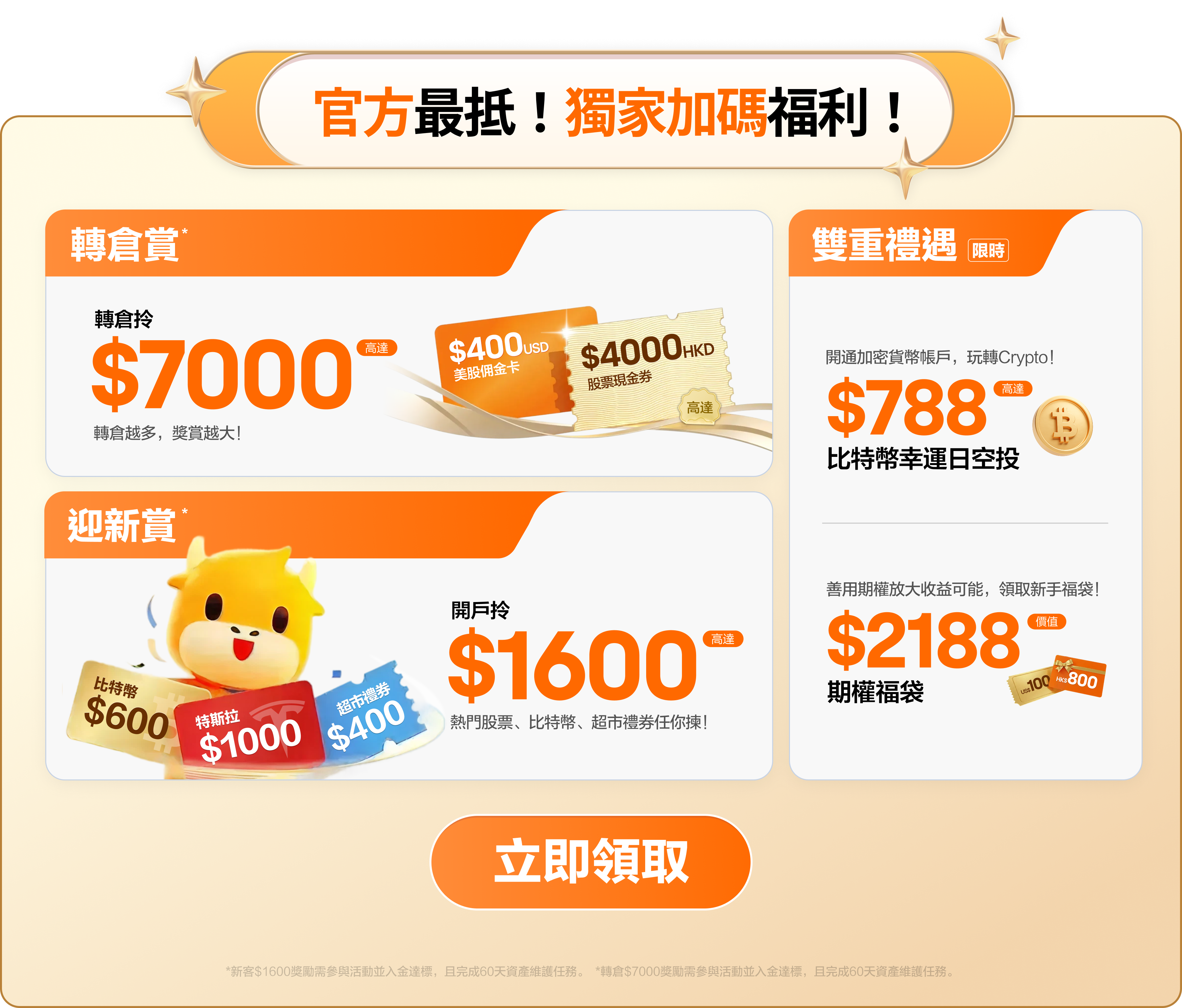
Complete the entire process online—open an account in as little as 3 minutes and start trading options such as Short Put and Covered Call. [New Customer Offer] For a limited time, enjoy a welcome bonus of over HK$1,000, plus a valuable $2,188 options gift pack waiting for you.
Potential Risks and Strategic Limitations
Every investment strategy has its dual nature. While covered calls can generate premium income and reduce the cost basis of a stock position, investors must fully understand the inherent risks and limitations.
Missing out on the gains from a sharp rise in stock price
This is the biggest "opportunity cost" of the covered call strategy. Once you sell a call option, your maximum potential profit is capped at the strike price. If the stock suddenly receives major positive news and its price surges from $50 to $80, while your strike price is $55, you'll be forced to sell at $55, leaving you to forgo the substantial gains above that level. Consequently, the covered call strategy is not well suited for stocks that you believe could experience explosive short-term growth.
Protection is limited when the stock price declines.
Although option premiums can provide some downside protection, this safeguard is quite limited. If the stock price plunges sharply, the loss could easily far exceed the premium you received. Returning to the earlier example, if you collected a $2 option premium but the stock price tumbled from $50 to $30, your paper loss would amount to $20—hardly enough to offset the damage. It's crucial to remember that a covered call is not a tool for hedging against market crashes; you still bear the vast majority of the downside risk associated with holding the stock.
How to choose the right stocks?
Not all stocks are suitable for implementing a covered call strategy. In the 2026 market environment, astute stock selection is key to the strategy's success.
Stock Selection Criteria in the 2026 Market Context
In the current economic cycle and interest-rate environment, investors may focus on the following types of stocks:
Blue-chip stocks with relatively stable fundamentals: Aside from international leaders such as NVIDIA (NVDA) and Google-A (GOOGL), Hong Kong‑listed Tencent Holdings (0700.HK) and CATL (3750.HK) have mature businesses and active options markets, making them suitable for Covered Call strategies.
Screening logic: Among U.S. and Hong Kong stock markets, the top two stocks by market capitalization; data date: May 29, 2026.
High-quality dividend‑yielding stocks or utility shares: These stocks generate steady dividend income on their own, and when combined with the premium from covered calls, they can deliver a "double‑dividend" effect.
Moderately volatile, high-quality growth stocks: Select shares that you're willing to hold for the long term but expect to enter a plateau or experience modest growth in the near term. Moderate volatility helps ensure substantial option premiums while keeping risk relatively manageable.
Avoid Common Stock-Picking Pitfalls
When selecting investment targets, proactively avoid the following types of stocks:
Highly volatile "penny stocks" or meme stocks: While they can offer exceptionally high option premiums, their price movements are unpredictable, posing substantial risks and easily leading to significant losses.
Stocks scheduled to report earnings: Stock prices typically experience sharp volatility around earnings announcements, with extremely high uncertainty. Unless you're prepared for dramatic price swings, it's best to avoid writing covered calls in the vicinity of earnings season.
Stocks facing significant negative news or adverse industry headwinds: Don't try to "rescue" a declining stock with a covered call. The strategy is designed to enhance returns, not to catch a falling knife.
Practical Steps for Implementing a Covered Call Strategy
On most international brokerage platforms commonly used by Hong Kong investors, executing a covered call strategy is very straightforward. Below is a general step-by-step guide:
Step 1: Log in to your brokerage account and confirm that you hold a sufficient number of the target shares (e.g., at least 100 shares for U.S. stocks).
Step 2: Go to the options trading interface, enter the ticker symbol of the stock you hold, and access its option chain.
Step 3: In the options chain, select an appropriate expiration date and strike price based on your market outlook.
Step 4: Click "Sell Call" or the corresponding option for your selected strike price, enter the number of contracts you wish to sell, and then confirm the trade and submit your order.
Conclusion: Is a Covered Call Right for You?
In summary, a covered call is an investment strategy designed to generate income with a more limited profit-and-loss range than a naked option sale, rather than pursuing substantial capital gains. By holding the underlying stock and repeatedly selling the same number of call options, investors forgo unlimited upside potential in exchange for immediate, steady cash flow and capped downside protection.
So, is a Covered Call right for you? If your investment profile meets the following criteria, it could very well be a powerful tool worth adding to your portfolio:
You are a long-term investor who holds several high-quality stocks that you do not plan to sell in the near term.
You hold a neutral or mildly bullish outlook on the short-term prospects of your stock holdings.
Your primary objective is to enhance your portfolio's cash flow, rather than pursuing rapid short-term appreciation.
You understand and are willing to accept the opportunity cost of forgoing the potential gains from a significant stock price increase.

Disclaimer: "Futubull" is a one-stop financial investment trading platform, with securities services provided by Futu Securities International (Hong Kong) Limited. This content does not constitute any offer, solicitation, recommendation, opinion, or guarantee regarding securities, financial products, or instruments. Options involve high risk; prices may fluctuate significantly, and investors may lose their entire principal.
