Bitcoin Handbag | What is Bitcoin? Playing games?
What is the price trend of Bitcoin? How should one invest in Bitcoin in 2026?
Futu's senior analyst, Feng Wenhui, stated that Trump's nomination of Kevin Warsh as Federal Reserve Chair and the partial U.S. government shutdown caused the cryptocurrency market to decline. However, she believes the market is currently prone to overinterpreting the Fed Chair nominee; once market liquidity improves, the policy direction may not be as unfavorable as the market expects for the Canadian dollar. At present, Bitcoin has entered "extreme fear" territory, and when the market falls into "extreme fear," it often presents a good opportunity for contrarian investing.
Latest BTC Price Movement
BTC/USD Instant Price Movement
Bitcoin trend analysis
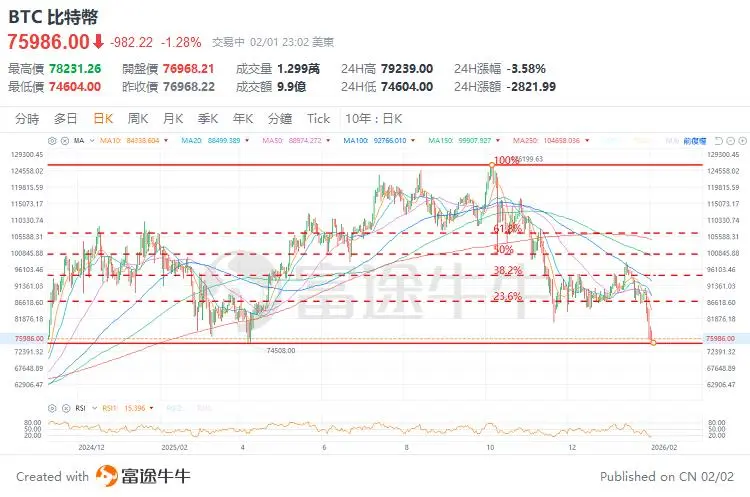
Futu Securities senior analyst Feng Wenhui pointed outCurrently, Bitcoin's Fear & Greed Index has dropped to nearly 15, entering "extreme fear" territory. Based on historical experience, when the market falls into "extreme fear," it often presents a favorable opportunity for contrarian investing. From the perspective of Fibonacci retracement levels, this wave's peak is near $126,000, with a potential downside target around $74,000. The initial resistance for a rebound lies near $86,000, with further upside possible toward $95,000. If we can indeed identify the bottom of this downward wave, there could be substantial room for a subsequent rally. For example, when Bitcoin dipped to around $75,000 last April, those who bought at the bottom later enjoyed returns exceeding 60%. Similarly, following the events of October 2021, Bitcoin continued to decline, at one point plunging into an extreme panic zone between $10,000 and $20,000. Those who managed to enter the market at that low point subsequently saw gains of nearly 20%. If history repeats itself, leveraging this indicator may help spot short-term opportunities to capitalize on a rebound.
Reasons for the Sharp Drop in Cryptocurrencies
Feng Wenhui stated that U.S. President Trump recently announced on social media his nomination of former Federal Reserve Board Governor Kevin Warsh as the next Fed chair. Warsh is widely regarded by the market as a "hawk," with monetary policy views sharply at odds with those of the current Fed leadership. Meanwhile, the partial U.S. government shutdown took effect on January 31, intensifying risk aversion and uncertainty in financial markets. Under the pressure of tightening global liquidity, cryptocurrency prices followed suit, briefly falling below $75,000 and plunging nearly 15% during the day, at one point dropping below the $2,200 level. However, given Trump's past approach, he will likely conduct repeated checks to ensure the nominee aligns with his objectives and can work effectively with him before making an official nomination. Otherwise, he would not nominate someone who stands in complete opposition to his own positions—especially since such a move could harm his midterm election prospects. The likelihood of this scenario occurring is virtually zero. Consequently, it cannot be ruled out that the market is currently overinterpreting the implications of the Fed chair nomination; should market liquidity improve, the policy direction may turn out to be less adverse for the Canadian dollar than currently anticipated.
Feng Wenhui is a licensed person with the China Securities Regulatory Commission (CE No.: BOD280), and neither she nor any of her associates holds any financial interest in the issuer of the aforementioned recommended shares.
Cryptocurrency Bill
In 2025, cryptocurrencies are drawing significant attention, with three bills—the CLARITY Act, the GENIUS Act, and the Anti-CBDC Act—taking center stage during Crypto Week. Below are the key highlights of each bill:
The CLARITY Act: Designed to establish a clearer regulatory framework, it clarifies the classification of digital assets and delineates regulatory responsibilities. In essence, it provides more precise guidance for the regulation of cryptocurrencies and digital assets, which, in the long run, will support the development of both digital assets and real‑world assets (RWAs).
The "GENIUS Act": Focused on regulating stablecoins and fostering their compliant development as payment instruments, the bill is expected to help bring stablecoins into mainstream use. Having passed the Senate, it currently aims to establish a comprehensive regulatory framework for stablecoins, reflecting a strategic intent to bolster the U.S. dollar's position in the global digital economy.
The "Anti-CBDC Act": Its core rationale is to safeguard citizens' financial privacy and prevent the government from using CBDCs to conduct comprehensive financial surveillance. This legislation will target efforts to oppose or restrict the development of central bank digital currencies (CBDCs), which could impede the advancement of the digital dollar.
Note that the aforementioned bills share certain commonalities. First, they seek to regulate and govern the scale of stablecoin and digital asset development, with the aim of fostering long-term, healthy growth and widespread adoption—this is one of the core rationales behind U.S. equities' stance on stablecoin speculation. Among these proposals, the most contentious is likely the "Anti‑CBDC Act." Proponents argue that it safeguards privacy and prevents excessive government interference, while opponents worry it could stifle financial innovation and leave the United States lagging in global competition. In essence, the crux of this legislation lies in striking a balance between cryptocurrency's "decentralization" and "regulation." Should the bill make progress during deliberations, it could prove significant for the long-term evolution of the crypto sector.
When we talk about "decentralization," Bitcoin naturally comes to mind, after all, the core investment rationale behind Bitcoin is that, according to its whitepaper, there will only ever be 21 million Bitcoins worldwide, and it remains free from interference by any government or central bank. Moreover, although the TACO trading concept has made the investment market less vulnerable to trade war risks, Trump's trade policies are very likely to continue eroding the U.S. dollar's standing in international markets. In my view, the concepts of "de-dollarization" and "decentralization" will keep gaining traction—this is the fundamental principle underpinning Bitcoin's potential to push prices higher still.
How to determine the Bitcoin price trend
Weak U.S. dollar
Assuming that Trump's trade policies do not alter the global trend toward de-dollarization,$USD(USDindex.FX)$The weakness is very likely to persist through 2025.
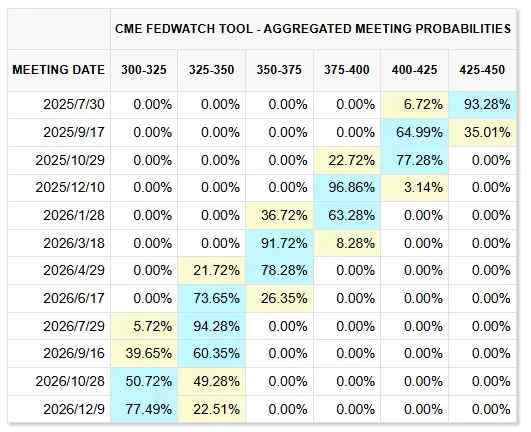
The trend of interest rate cuts remains unchanged.
Although the U.S. debt issue is likely to remain a hot topic in the second half of the year—with concerns about default risks, for instance, expected to persist into June—the underlying pressure on U.S. public finances remains substantial. Moreover, the "Big and Beautiful" bill could further fuel market anxieties about the fiscal deficit. More importantly, the U.S. economy is currently only in a disinflationary phase; even if interest-rate cuts do materialize, they will probably be gradual, leading to a slow decline in U.S. Treasury yields. As long as this downward trend continues, it should continue to support risk‑asset performance in the second half.
Rarity and the strategic reserve strategies of various countries
Bitcoin, with its fixed supply of 21 million coins and its "decentralized" nature, is regarded by investors as "digital gold," making it well-suited as a reserve asset. This year, the United States officially established the "Strategic Bitcoin Reserve," using confiscated Bitcoin as its reserve asset. As regulatory frameworks improve and long-term development takes shape, it remains to be seen whether the U.S. will expand its strategic Bitcoin‑holding strategy. Meanwhile, whether more countries will adopt a more favorable or relaxed stance toward Bitcoin and cryptocurrencies is also a key factor supporting upward price momentum.
When it comes to scarcity and de-dollarization, investors naturally think of gold.$Gold Main Contract (GCmain.US)$The price has also shown a solid upward trend since the beginning of the year, and the gold price's upward movement suggests that market demand for scarce assets remains strong. We believe that the price trends of gold and Bitcoin should maintain a positive correlation.
Bitcoin trading platform
Futu Securities is a licensed entity regulated by the Hong Kong Securities and Futures Commission, compliantly offering virtual asset trading services. Investors can directly use Hong Kong dollars or U.S. dollars to purchase spot Bitcoin and Ethereum, with a low investment threshold as low as HKD 80/USD 10, and you can even deposit and withdraw cryptocurrencies through Futu.