Technology Stock Investment Guide
Following the Nasdaq's rebound, how should you invest in U.S. tech stocks?
In the U.S. stock market, technology stocks have long been the focal point of investor interest. When it comes to U.S. tech stocks, investors most often refer to the "Magnificent 7," namely:$Apple(AAPL.US)$ 、$Amazon(AMZN.US)$、 $Alphabet-A(GOOGL.US)$、 $Meta Platforms(META.US)$ 、$Microsoft(MSFT.US)$、 $Tesla(TSLA.US)$and$NVIDIA(NVDA.US)$They span consumer electronics, cloud computing, advertising, electric vehicles, and AI‑powered computing—essentially a microcosm of the U.S. tech sector's core themes.
In addition, the market continues to closely monitor the storage and semiconductor sectors, including…$Micron Technology(MU.US)$ 、$SanDisk(SNDK.US)$ 、$SK hynix(SKHY.US)$、 $Advanced Micro Devices(AMD.US)$、 $Broadcom(AVGO.US)$、 $Taiwan Semiconductor(TSM.US)$and so on. Following the pullback, investors are reassessing the outlook for technology stocks and semiconductors. Market participants are typically eager to understand whether this rally can sustain itself, what underlying shifts are being reflected by large-cap tech stocks versus memory‑chip equities, and how Hong Kong investors can participate in U.S. equity trading. The following discussion will explore these topics, from the broader context of the rebound and key market concerns to practical trading strategies.
Why are so many people paying close attention to the rebound in U.S. tech stocks right now?
This round of renewed attention is typically driven by several factors occurring simultaneously.
1) Following the pullback, valuation pressures have eased temporarily.
After a pronounced pullback, crowded trades in tech stocks and semiconductors typically cool down. As share prices retreat and market expectations adjust, a rebound becomes more likely once earnings reports or sentiment‑driving catalysts emerge. This is why "tech stocks after a correction" often reenter the spotlight of searches and discussions.
2) The financial reports of Microsoft and Amazon have become key validation for AI monetization.
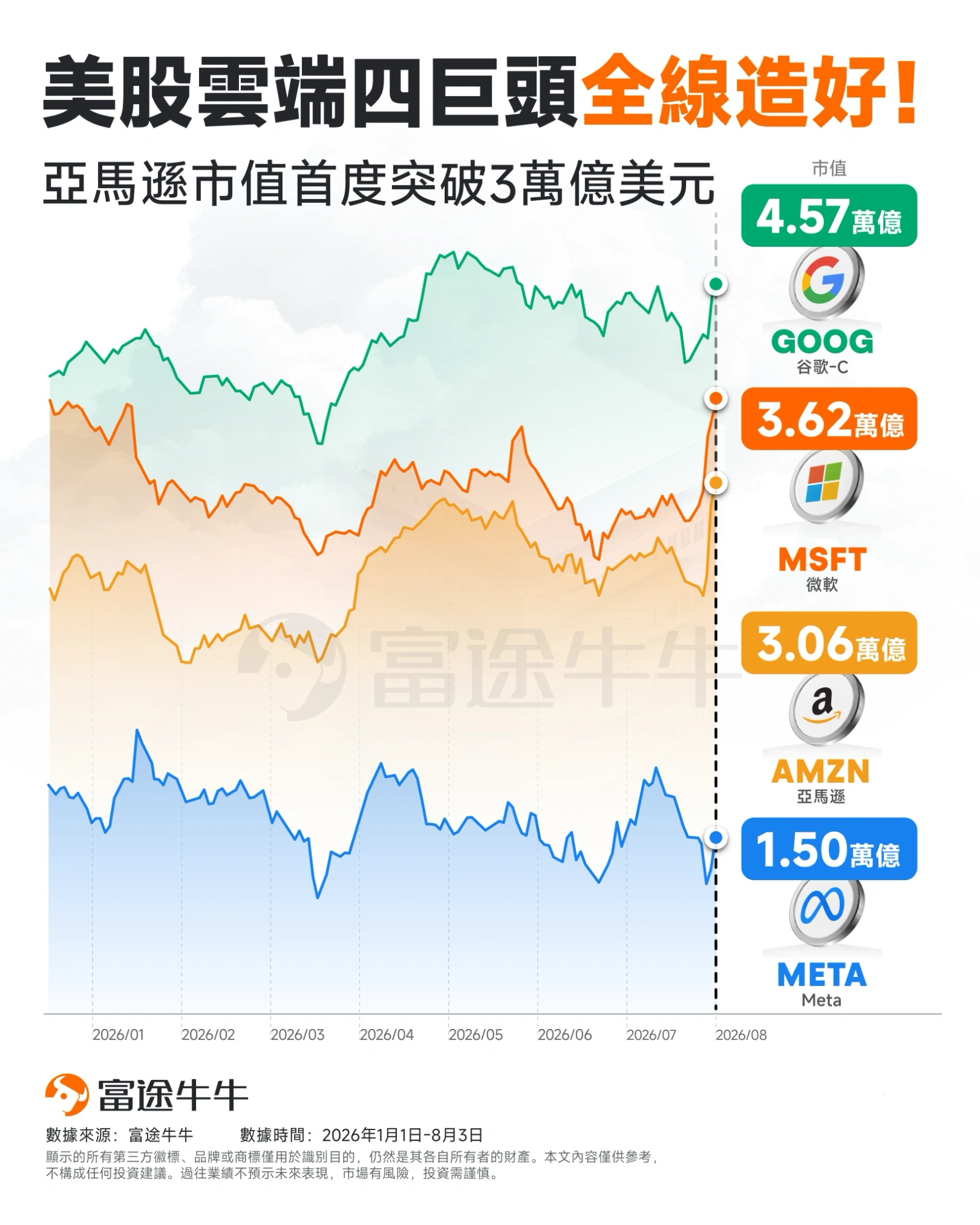
The most immediate catalyst for the market lately has come from the earnings reports of cloud computing giants.$Microsoft(MSFT.US)$The latest quarter showed that revenue from Azure and other cloud services grew by approximately 43% year over year, with Azure's full-year revenue surpassing $100 billion for the first time. Following the earnings release, the stock surged, and its market capitalization posted a single-day gain that at one point set a new record.$Amazon(AMZN.US)$Equally impressive, AWS revenue grew by roughly 37% year over year, marking its fastest pace in about 18 quarters, while its stock price surged accordingly and its market capitalization briefly surpassed the $3 trillion threshold.
These two earnings reports are significant because, until now, the market's biggest concern wasn't whether anyone was investing in AI, but rather whether the money being poured into it could translate into revenue. Microsoft and Amazon have demonstrated through their cloud‑based growth that demand for AI is turning into verifiable commercial results, prompting capital to flow back into tech stocks.
3) Semiconductors and memory have become areas of high elasticity.
When the Philadelphia Semiconductor Index strengthens after a correction, sectors such as memory, ASICs, and equipment and materials often come into focus simultaneously. Consequently, themes related to DRAM, HBM, and NAND tend to be discussed more frequently alongside the broader "semiconductor rebound." This linkage becomes particularly pronounced when cloud‑service providers maintain high capital expenditures and memory costs rise.
4) The macro environment is turning more favorable, boosting risk appetite for growth stocks.
If oil prices and U.S. Treasury yields decline, boosting risk appetite, this typically supports a valuation recovery for growth stocks. Technology stocks are particularly sensitive to interest rates and market sentiment; when the macro environment turns more favorable, the Nasdaq and the semiconductor sector often lead the way.
Following the Nasdaq's rally, which sectors are attracting investor attention?
When tech stocks rebound, capital and discourse rarely stop at the term "tech" itself; instead, they tend to zero in on more specific areas. Recently, the market has been paying close attention to:
Focus Direction | What is the market looking at? |
AI computing power | Training and inference requirements, capital expenditures |
Memory/Storage | Supply, Demand, and Pricing of HBM, DRAM, and NAND |
Cloud and Applications | Can AI be turned into a sustainable revenue stream? |
Consumption and Platforms | Ecology, Infrastructure, and Traffic Monetization |
Indices and ETFs | Overall Performance of the Market and Sectors |
The focus of this round of discussion is not merely on whether the index rises or falls, but on whether three key factors have improved simultaneously:
Has the demand for AI computing power continued?
Has the supply-demand balance in the memory market improved?
Can the application layer deliver on revenue?
This round of earnings reports from Microsoft and Amazon has precisely reinforced the third point: cloud computing has become one of the AI monetization pathways that the market can more easily validate. As the tech stock rally shifts from "sentiment-driven recovery" to "industry validation," the market typically examines these trends across the board, rather than focusing solely on the performance of a single sector or company.
How to interpret U.S. AI stocks: Hardware and applications should be evaluated separately.
AI concept stocks refer to shares of companies whose core businesses involve artificial intelligence technologies. As consumer‑oriented AI applications like ChatGPT gain widespread adoption, Wall Street's focus has shifted from merely chasing hardware to increasingly emphasizing software monetization and commercialization capabilities.
AI Hardware: First Look at Computing Power, Then at Memory
The computing power segment reflects the demand for GPUs, custom-designed chips, and advanced manufacturing processes in AI training and inference. When discussing this area, the market often mentions…$NVIDIA(NVDA.US)$ 、 $Advanced Micro Devices(AMD.US)$ 、 $Broadcom(AVGO.US)$ 、 $Taiwan Semiconductor(TSM.US)$Key areas of focus typically include cloud vendors' capital expenditures, order visibility, and earnings‑report sensitivity in the context of high growth expectations.
The memory/storage sector reflects the downstream demand for HBM, DRAM, and NAND following the expansion of data centers. When the market discusses this segment,$Micron Technology(MU.US)$ 、 $SanDisk(SNDK.US)$ 、 $SK hynix(SKHY.US)$It appears with relatively high frequency. The focus is increasingly on memory prices, improvements in supply and demand, and whether the pull from AI servers on high-end storage will persist. Notably, when Amazon revised its capital expenditure outlook, it also cited rising memory costs, indicating that the linkage between the storage sector and cloud expansion is strengthening.
In a rebound market, two distinct sectors often come into focus one after the other. As a result, semiconductor‑related stocks—particularly those tied to computing power—and memory‑chip stocks are frequently discussed in tandem, though their underlying drivers differ: the former is more closely linked to capital expenditures on computing capacity, while the latter is more aligned with storage‑cycle dynamics.
AI Applications: The Key Is Whether They Can Deliver Revenue
At the application level, the market is more concerned with whether companies can turn AI technologies into sustainable revenue. Following this earnings season, Microsoft and Amazon have become the most closely watched case studies: the former has boosted investor confidence with progress in commercializing Azure and Copilot, while the latter has demonstrated robust cloud demand through AWS's accelerated growth.$Alphabet-A(GOOGL.US)$More often corresponds to search, advertising, and the cloud;$Meta Platforms(META.US)$It is often used to assess AI's impact on advertising efficiency and the content ecosystem, but its capital expenditure and profit pressures have also made the market more sensitive to a "spend‑first, deliver‑later" business model.
At the application layer, the focus is often less on the sheer buzz surrounding a particular theme and more on whether the revenue model is clear and whether growth is demonstrable. When hardware leads the way and applications follow, the rally in tech stocks tends to be more broadly sustained.
Is this a continuation of the rebound, or merely a short-term emotional correction following an oversold pullback?
To determine whether this round of U.S. tech‑stock rally can persist, we can first examine three key dimensions:
Observation Dimension | More like a continuation of the rebound. | More like a short-term sentiment recovery. |
Financial Results and Guidance | AI-related revenue, cloud growth, and capital expenditures continue to deliver results. | Only if sentiment improves will earnings or guidance remain weak. |
Plate spreading | From the cloud and applications to computing power and memory | Only a few directional pulses are rising. |
Valuation and Funding | Valuation pressures have eased following the callback, and capital continues to flow back in. | Valuations remain relatively expensive, and trading activity has declined rapidly. |
In short:
With performance validation, sector-wide expansion, and easing valuation pressures, the sustainability of such trends is typically high.
If relying solely on emotional impulses, it would be closer to a short-term correction.
The sharp post‑earnings rallies of Microsoft and Amazon have indeed eased market concerns about AI's returns in the short term; however, the outlook still hinges on whether cloud‑computing growth can sustain itself, whether capital‑expenditure returns remain stable, and whether hardware segments such as computing power and memory are keeping pace. If only the cloud‑computing stocks rally while other sectors lag behind, the sustainability of the rebound will warrant a more cautious assessment. Moreover, it's worth noting that memory and storage‑related stocks tend to be closely tied to price cycles and supply‑demand expectations, with short‑term volatility often exceeding that of large tech stocks. Understanding their role within the broader industry is far more important than focusing solely on daily price swings.

Investing in U.S. stock ETFs: If you want to gain exposure to a particular sector, you don't necessarily have to focus on a single company.
If you're interested in the overall performance of U.S. tech stocks rather than a single company, you can start with U.S. equity ETFs. An ETF is like an "investment basket," allowing you to hold a diversified portfolio that tracks a specific index or sector, while trading it as freely as a stock.
Common observation methods include:
Use technology‑related ETFs or Nasdaq‑focused ETFs to gain exposure to the broader market and the tech sector.
Use semiconductor-related ETFs to gauge the overall performance of the chip sector.
Use S&P 500–related ETFs to gauge the broader U.S. stock market's rhythm.
For investors who wish to reduce the volatility of a single company and first grasp the sector's direction, ETFs are one of the most common ways to participate in the market. Especially during periods of intensive earnings reports, it's clearer to first use ETFs to gauge sector strength and then analyze individual stock differences. On Futu, you can easily find various U.S. stock indices and thematic ETFs. Experience it now >>
How should you invest in U.S. tech stocks?
If you want to start learning about or trading U.S. tech stocks, the practical steps are usually quite straightforward:
Download and log in to the Futubull App
Activate U.S. stock trading permissions
Search for a stock symbol or company name, such as MSFT, AMZN, NVDA, MU, SNDK, SKHY, AMD, AVGO, TSM, QQQ, SMH.
View market quotes, financial reports, and news.
To place an order, you can use a limit order or a conditional order according to your needs.
