[Interest Rate Cycle] How to deploy US interest rate cuts
Joint Stock Exchange Report: 2025 Downturn Drives Global Risk Assets to Rise
As Fed Chairman Will delivered a speech at Jackson Hole, the prospect of a near 2% increase in occupational risks indicated that MMF policy will move towards broadening. Market expectations are likely to double in 2025. Lower interest rates and gains in non-U.S. stocks are key factors, economic stability and regulatory controls. AI TECHNOLOGY CONSOLIDATION CONTINUES TO DRIVE GROWTH IN TECHNOLOGY SHARES, PLUS UP-MARKET RISK, RISK-ON, SHORT-TERM PROFIT GROWTH IN STOCKS SUCH AS SEMICONDUCTOR SECTORS AND NVIDIA'S IMMEDIATE PUBLIC PERFORMANCE. The US stock market trend remains upward.
Will the US cut interest rates in 2025?
Fed Chairman Jerome Powell said at the Jackson Hole meeting that the news undermined the US equity performance, Global Risk Asset Prices rose, and Cryptos and Chinese stocks showed an uptick in the last five weeks. Kwale spoke at the Economic Policy Seminar on Economic Outlook and the Framework. This time served as a signal of Fed policy direction, a strong adjustment of the increase in business risks, an improvement in the circulation trend, and a clear indication of the imminent adjustment of the MMF policy. The following are the main points of the speech:
1. Rising employment risks: The labor market has cooled from overheating, but the unemployment rate is stable and risks are increasing, emphasizing that “the risk of decline in employment is rising” and maintaining stable employment is a priority. This reflects the Fed's policy focus shifting from fighting inflation to balanced employment.
2. Trend improvement: The circulation has returned from a plateau value to an acceptable level, approaching the 2% target. Powell indicated that the rate of decline has fallen to the level of footfall, and confirmed that an MMF policy adjustment may be coming soon, indicating that the start of the decline began in September.
3. Policy Rate Adjustment: The current policy rate is 100 basis points lower than last year's neutral rate (1%), Powell hinted that the Fed is prepared to lower rates in response to the risks of economic slowdown, but the extent and timing of the adjustment will depend on the data.
4. Framework Review: Re-applying the IMF's MMF is effective and will not continue to monitor traffic and employment data to avoid overreaction.
As far as financial markets are concerned, the decline in the neutral interest rate is the decrease in the non-nominal interest rate. The information is more focused on the stable performance of the US economy, strengthening market confidence. From the point of view, the Fed will focus on a number of moving market data in the short term, such as non-farm employment data and loss rates only increase in the downward pressure on the economy. The MMF policy will shift towards a more broad-based approach in response to the downward pressure on the economy.
US Interest Rates Futures Market Forecast Changes
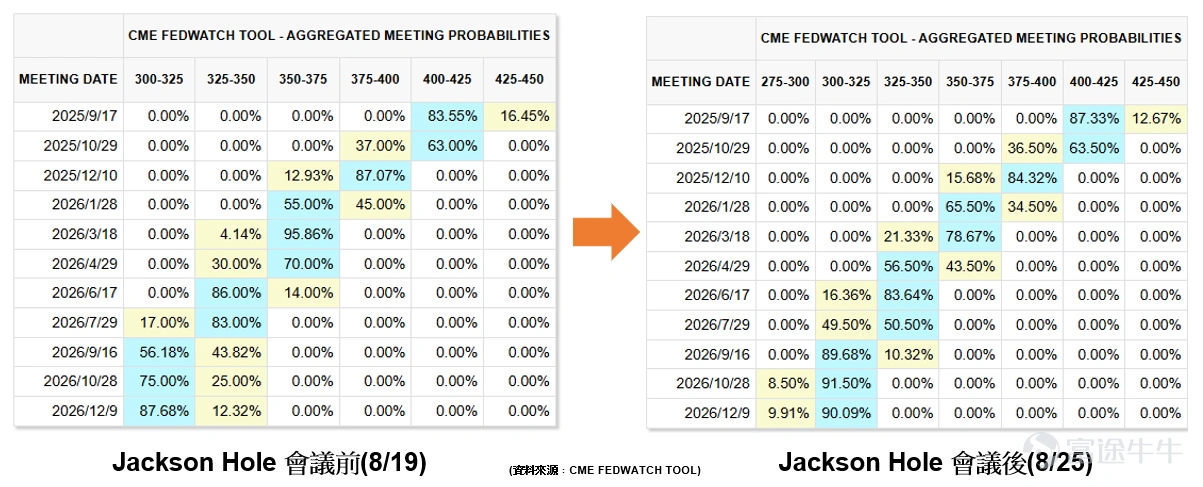
Whale emerged from a clear field of celebration at Jackson Hole, with no more than a hint of the expected change in interest rates and no medium in sight. The above is the forecast for CME Interest Rates. After a week's change, it can be seen in the chart that the future of interest rates will increase downwards and have no apparent mediocrity. By 2025, the lower interest rate is likely to be reduced by more than half to 3.75~4.00cm. In the year 2026, one is down to 3.00~3.25cm.
The idea is that interest rate declines are not the main consequence of the rise in US equities, but stable economic growth and at the same time are under control. The decline in the neutral rate is a true reflection of the occurrence of the conditions described above. Neutral Interest Rate (Neutral Interest Rate) is a balanced interest rate level set by the Federal Reserve Bank that does not cause overheating of the economy and does not control economic growth (leading to deflation). When talk of a neutral interest rate fall comes out, the Fed will ignore the risks of the economic downturn, and the IMF will have monetary policy to counteract the downward pressure on the economy and maintain economic stability.
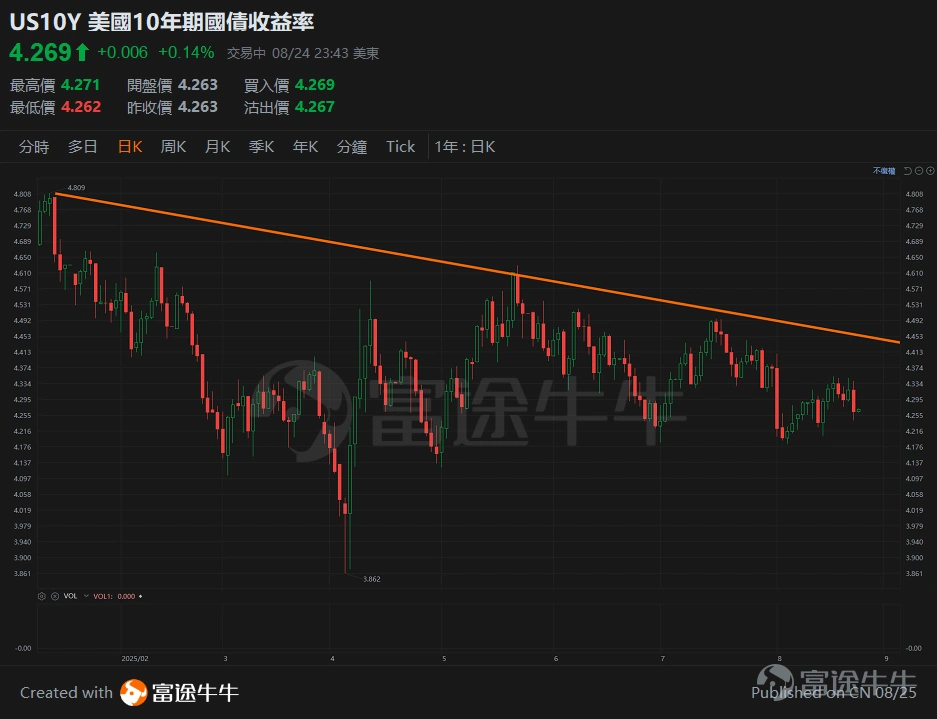
Therefore, looking at the performance of US bonds, for example, $U.S. 10-Year Treasury Notes Yield(US10Y.BD)$ Rate performance remains above 4pc for now, but the downtrend should not change. RISK-FREE INTEREST RATES ARE SHOWING SIGNS OF SLOWLY FALLING BACK FROM HIGHS, WHICH IS AN IMPORTANT ELEMENT IN THE PERFORMANCE OF FINANCIAL MARKETS. When interest rates fall too noticeably, fear the risk of recession.
Other than rising interest rate expectations, what are the reasons for U.S. stocks to be stimulated?
In addition to the Fed's dovish rhetoric, the recent shift in the market's interpretation of officials has been another reason. IN THE LEAD-UP TO THE JACKSON HOLE MEETING, MARKETS FOCUSED ON LAST MONTH'S FED MINUTES, WHICH MENTIONED “UPWARD INFLATION PRESSURES REMAIN MORE WORTHWHILE BETWEEN INFLATION AND EMPLOYMENT RISKS,” A MOVE THAT LED MARKETS TO WORRY ABOUT THE RISKS BEHIND FED POLICY AND THE ECONOMY AFTER PPI ROSE ABOVE MARKET EXPECTATIONS LAST MONTH IN THE US. The signals released by the Federal Reserve at this economic policy seminar are a key factor in helping the stock market to stabilize.
At the moment, the performance of low interest rate environmental growth stocks will lead to the transfer of funds from hedge assets to riskier assets. More important for Technology stocks is the growth and application of AI technology, which is the driving force of all technologies in the economy at the heart of investment.
U.S. Stock Short-Term Trading Judgment
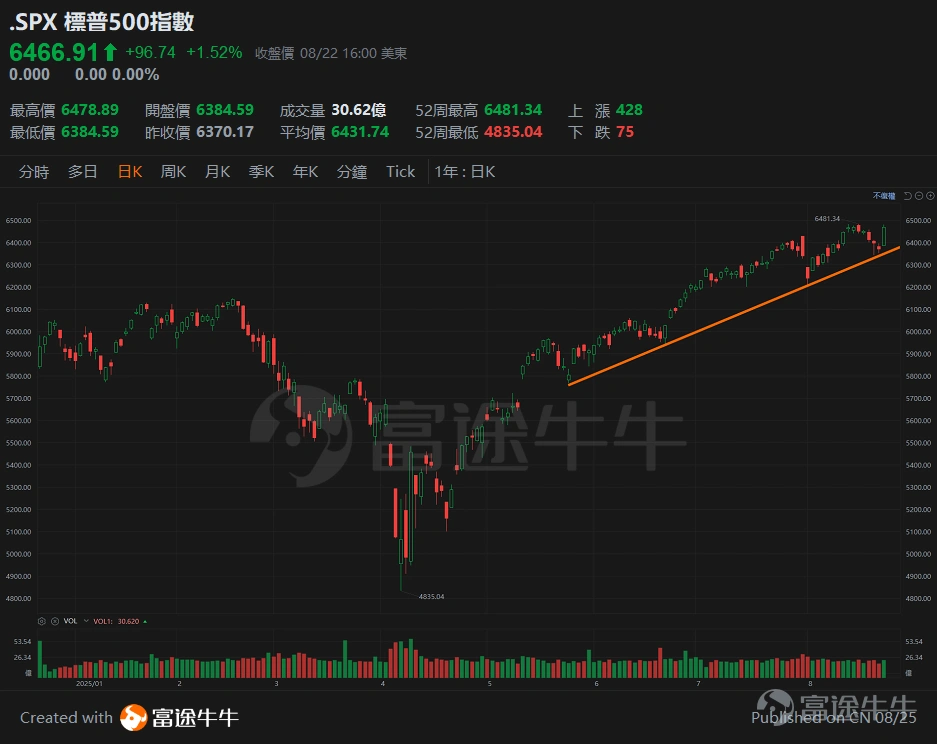
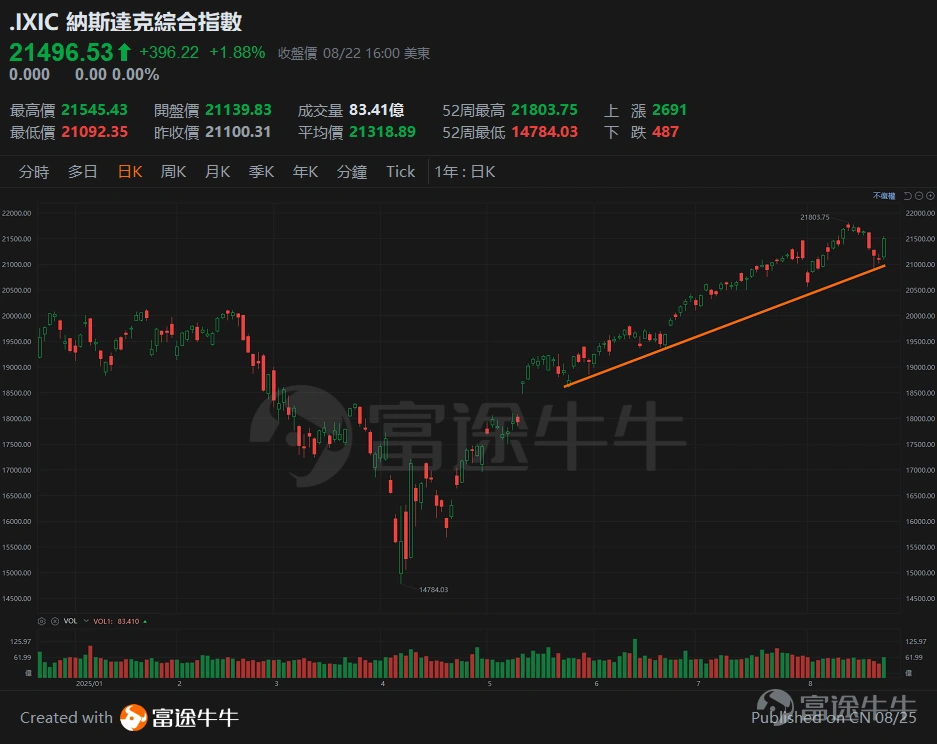
$S&P 500 Index(.SPX.US)$ und $Nasdaq Composite Index(.IXIC.US)$ Still on a medium-short upward trajectory, the uptrend has not changed so far. $Russell 2000 Index(.RUT.US)$ und $Dow Jones Industrial Average(.DJI.US)$ Follow closely and separate the founding years and historical highs. In the near future, the perception of downturns is out of the way of the market, and some Technology Industries look to prepare for quality. In addition to the Palantir Air Institutions report mentioned earlier this week, MIT indicates that 95% of institutions only receive market reports after their investments. People who do not understand that this news will lead the market to the development of the AI Industry, are just some investors who do not trust the market with a lack of confidence in the market to create short-line loans.
As the market moves back, this variety of news is likely to get weaker. Technology stocks may continue to bounce back after the market. It is not until this time that a small adjustment appears, it is good to show that the spread of investments is good, for example, after the trend has been compared to the current period, the performance of the reversal is stable, for example, for some stocks that are resistant to current failures, such as $Johnson & Johnson(JNJ.US)$ $Verizon(VZ.US)$ $McDonald's(MCD.US)$ $3M(MMM.US)$ or some financial stocks such as $Goldman Sachs(GS.US)$ und $JPMorgan(JPM.US)$ Support, other industrial stocks such as $Caterpillar(CAT.US)$ It has remained strong to this day.
Not looking at the extreme short line angle, the main areas of the top five rally stocks are stocks with high economic sensitivity. While the market is right on the RISK-ON stage, the angle for shortwave investments is to follow BETA as the main, select Technology stocks. If NVIDIA, which is due to publish its results on August 27, the market is not expected to release new chips for the B30A by the end of the week, this announcement may be an opportunity to rebuild the RSO Semiconductor Boards, and in the short term it may increase the investment appetite for the entire sector. (Data Source:NVIDIA B30 performance or 80% of Blackwell GPU“)
Closely adjusted large Technology stocks can be traced from technical analysis, and the current trend can be traced from technical analysis. While the Google Index has reached a new all-time high, Tesla's shortwave trend is strong this month, and much of the money may have just been moving from the sector.
Semiconductors: $NVIDIA(NVDA.US)$ $Broadcom(AVGO.US)$ $Advanced Micro Devices(AMD.US)$ $Taiwan Semiconductor(TSM.US)$ $Intel(INTC.US)$
Large Technology Shares: $Microsoft(MSFT.US)$ $Meta Platforms(META.US)$ $Amazon(AMZN.US)$ $Apple(AAPL.US)$ $Alphabet-C(GOOG.US)$ $Tesla(TSLA.US)$ $Palantir(PLTR.US)$ $Netflix(NFLX.US)$
Futu Securities, Chief Analyst, Hui Chi-Lok
(The author is a licensee of the Securities and Exchange Commission and its affiliates do not have any financial interest in the proposed issuer of shares)
